
Ultimate Resource On Baby Formula Shortage
Demand Is Up At Human Milk Banks Amid Baby Formula Crisis. Ultimate Resource On Baby Formula Shortage
Inquiries for pricey donor milk have risen, but banks are relatively scarce and can only service so many families.
Updated: 1-6-2026
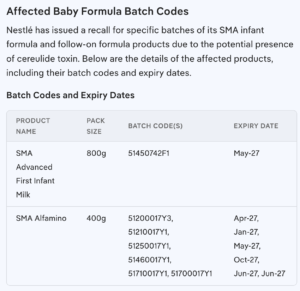
Several Baby Formulas Recalled Over Toxin Presence!!!
Nestle recently issued a global recall of some baby formula products due to concerns over a toxin that can cause food poisoning.
Nestlé Infant Formula
Recall Date: January 6, 2026
Reason: Potential contamination with cereulide, a toxin that can cause food poisoning.
Affected Products: Specific batches of SMA infant formula and follow-on formula sold globally, including brands like Guigoz and Nidal in France, and Beba and Alfamino in Germany.
Action: Consumers should check batch numbers and discontinue use of affected products. Refunds are available.
Abbott Infant Formula
Recall Date: Ongoing since February 2022
Reason: Contamination concerns related to Cronobacter sakazakii and Salmonella Newport.
Affected Products: Certain Similac, Alimentum, and EleCare formulas with specific lot codes.
Action: Parents should not use affected formulas and check for specific lot codes.
Notably, a batch of Aptamil First Infant Formula in the UK was recalled due to the presence of a toxin called cereulide, and ByHeart infant formula was recalled due to a botulism outbreak linked to its products.
Recent Infant Formula Recalls
Aptamil First Infant Formula Recall
Product: Aptamil First Infant Formula
Manufacturer: Danone
Batch Code: EXP 31-10-2026
Issue: Contains cereulide toxin, which can cause vomiting.
Affected Sales Period: Sold between May and July 2025.
Action: Parents should return the affected batch for a full refund, with or without a receipt.
ByHeart Whole Nutrition Infant Formula Recall
Product: ByHeart Whole Nutrition Infant Formula
Issue: Linked to an outbreak of infant botulism, affecting 51 babies across 19 states.
Contamination Source: Dried milk powder tested positive for botulism bacteria.
Action: All ByHeart products have been recalled. Parents should stop using these products immediately and seek medical attention if symptoms develop.
Symptoms To Watch For
Cereulide Exposure: Nausea, vomiting, abdominal cramps.
Botulism Symptoms: Constipation, poor feeding, loss of head control, difficulty swallowing, which can progress to respiratory issues.
Recommendations For Parents
Check for the affected batches of Aptamil and ByHeart formulas.
If you have these products, do not use them and return them for a refund.
Consult a healthcare provider if your baby shows any concerning symptoms after consuming these formulas.
Meanwhile..
The worsening baby formula shortage is pushing more parents to explore an even pricier alternative: Human breast milk supplied by donor banks.
Inquiries for donor milk have risen by 20% since the beginning of the shortage, said Lindsay Groff, the executive director of the Human Milk Banking Association of North America.
That follows a record year of distribution: The HMBANA’s member banks dispensed 9.2 million ounces to the families and hospitals of babies in need in 2021, a 22% increase from 2020, Groff said. Calls from those who are interested in donating milk are picking up, too.
Related:
* Breastfeeding vs Formula vs Cow’s Milk
* Low Breastfeeding Rates And Public Health In The United States
* Change In Infant Feeding Practice
* Infant Feeding And Infant Health
* Campaigns For “More Mother-Fed Babies” And Pure Cows’ Milk
* The Fall And Rise Of Breastfeeding Initiation Rates
* Human Milk And Human Health: A Dose–Response Relationship
* Increasing Breastfeeding Rates Today
* Can History Inform Breastfeeding Campaigns Today?
Demand for donated milk is “likely to increase as these things go on and the shortage continues and people are feeling more stressed and scared and desperate,” Groff said.
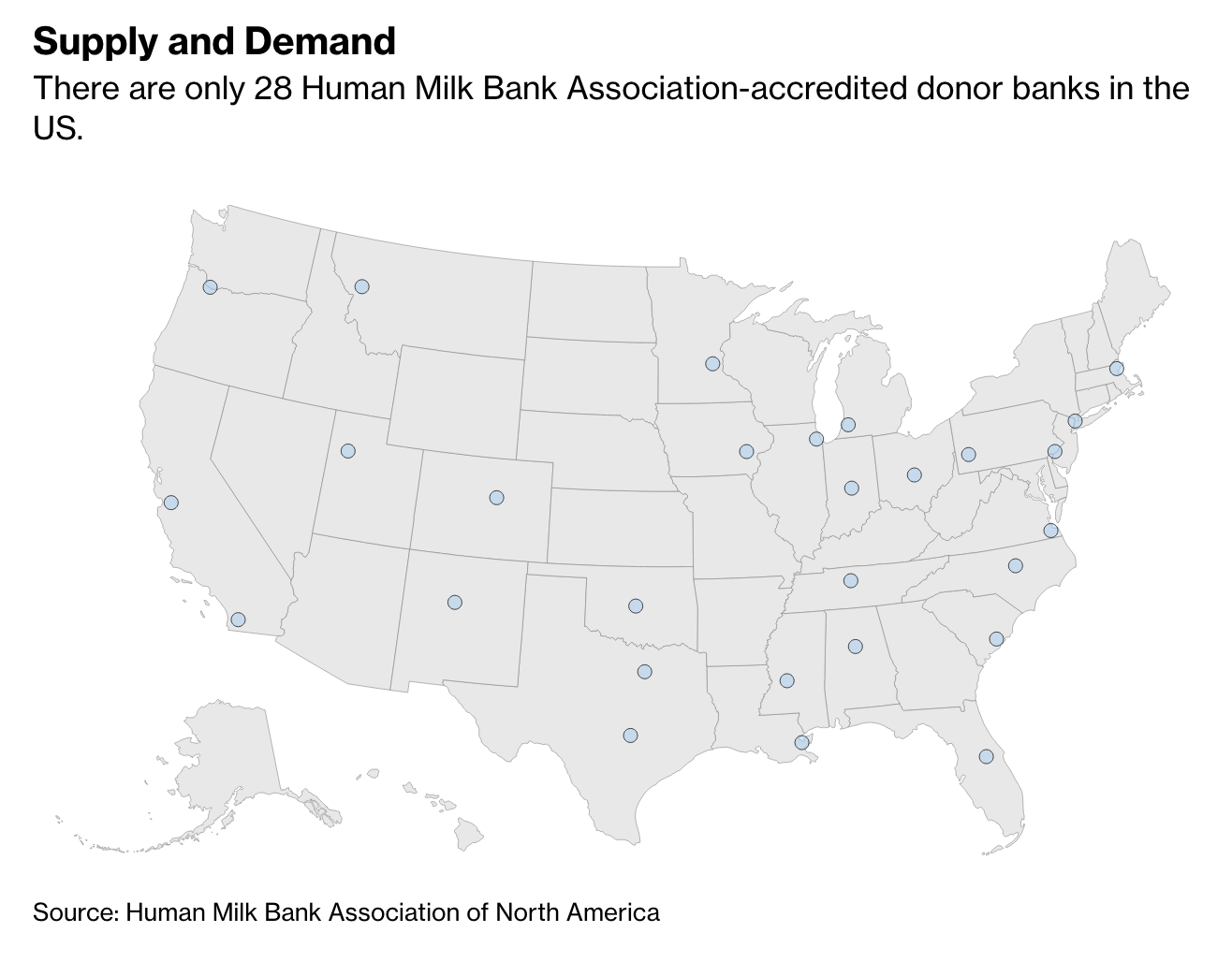
The increased interest comes amid skyrocketing out-of-stock rates for formula that have put pressure on the White House to take steps to ease the supply crunch. Human milk banks, though, can only provide so much relief: They are relatively scarce in the US, and the cost of their offering is often greater than for formula.
There are 28 milk banks accredited by HMBANA in the United States, with an additional three in Canada. Banks accept donations that have been dropped off at specified locations or have been overnighted to a given facility, before being screened, tested, and pasteurized.
The US Food and Drug Administration recommends against using milk that has not been vetted, though it was not involved in establishing those guidelines.
Donor milk can cost anywhere from $3 to $5 an ounce. Some formula labels can cost $1 per ounce, while others sell for about 50 cents per ounce, Parents magazine notes. (That’s without any potential price increases due to scarcity or price-gouging.)
Milk banks often work with parents to address costs, such as sliding-scale programs and fundraising efforts to cover costs. And many parents consider the price tag worth it.
Laura Herold, a mom in Brooklyn, New York, said her five-month-old was first given donor milk in the hospital shortly after her birth. Herold kept purchasing it after being discharged.
“It wasn’t cheap,” she said. “At the time, we just didn’t care. We wanted to feed our baby.”
Donor milk is largely considered by experts to be the gold standard if breastfeeding is not an option, given its ability to decrease the risk of life-threatening diseases, especially for preemies. But doctors also warn against shaming parents for using formula, given the myriad cultural, economic, and biological hurdles that might make formula-feeding the only viable option.
Milk banks prioritize sourcing milk to what Groff with the HMBANA calls “medically fragile” babies, such as those born prematurely. Families and caregivers of healthy infants can receive up to 40 ounces of breast milk without a doctor’s prescription.
Serving all of those who are interested may prove challenging: Donations became scarcer earlier this year, coinciding with a widespread return to work — a shift that meant many lactating parents were coming back to workplaces that lack dedicated pumping rooms, sufficient breaks, or paid parental leave.
Doctors have recommend against both homemade formulas as well as diluting supplies on hand to stretch resources. Some retailers are currently limiting the maximum number of formula products to three per customer, and parents are setting up online alerts and coordinating with one another in Facebook groups and other forums for support.
Even when the formula supply chain improves, Groff expects resilient demand for donor milk. “Babies are born every day, and not every parent can breastfeed,” Groff said.
Updated: 5-18-2022
Here’s How To Buy Baby Formula Online During The Shortage
Finding baby formula amid the nationwide shortage takes patience and luck. These websites alert you to the availability of Similac, Enfamil and other brands at major online retailers.
If you’re one of the many parents looking for baby formula, there are automated services that will scour the internet for you. Just keep your credit card handy because retailers sell out quickly.
Free online inventory trackers—used by frenzied shoppers during the holiday season to track down Sony PlayStations and other hard-to-find hot gifts—have added baby formula to their radars.
After Abbott Laboratories recalled several powdered formulas in February, leading to nationwide shortages, parents began submitting requests to stock-monitoring platforms including NowInStock.net, ZooLert.com and HotStock.io. The websites, which also helped people find Covid-19 test kits amid scarcity, run software that recurrently checks inventory at major online retailers. (You can learn more about how this works in my video.)
“At first, only a few infant formulas were hard to find,” said Tony Nguyen, creator of ZooLert. “Now almost every one of them sells out quickly.” The website searches for inventory updates on the most popular products every 45 seconds.
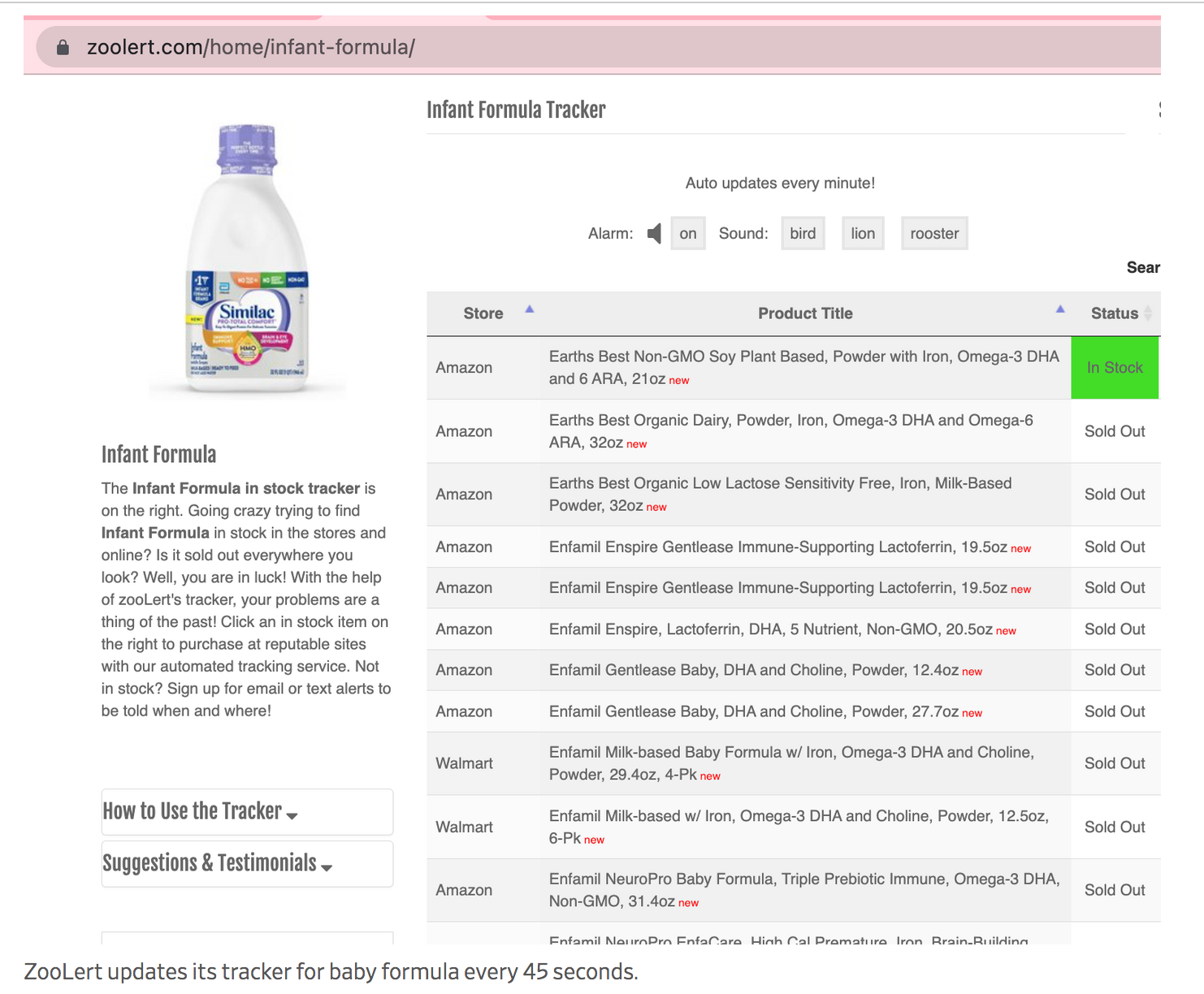
Each of the three sites lists baby formula on the landing page, making the category easier to find. They also include links to items available for preorder and show the last time they were in stock.
Within seconds of product becoming available, the tracking websites can update and send alerts to users who sign up and opt in. On Monday, ZooLert indicated a 24-pack of Abbott’s Similac Total Care was available at Walmart. The ready-to-feed formula showed as sold out about a minute later. NowInStock showed a 12.6-ounce canister of Enfamil available at Target. It sold out the same day.
The Biden administration launched its own website Friday to point families toward local food banks and government-aid services that can help provide formula. The administration also said it is working with companies to get more formula on shelves more quickly, including flying in formula from overseas.
Meanwhile, trackers may help you find the scarce supplies locally. If you decide to use the trackers, getting an email or text about product availability is just the start. You’ll still need to respond to the alert fast. And don’t wait until you’re completely out of formula to use the trackers—alerts aren’t guaranteed, and not all retailers will deliver to your home at the same speed.
Here’s How To Use An Inventory Tracker To Find Baby Formula:
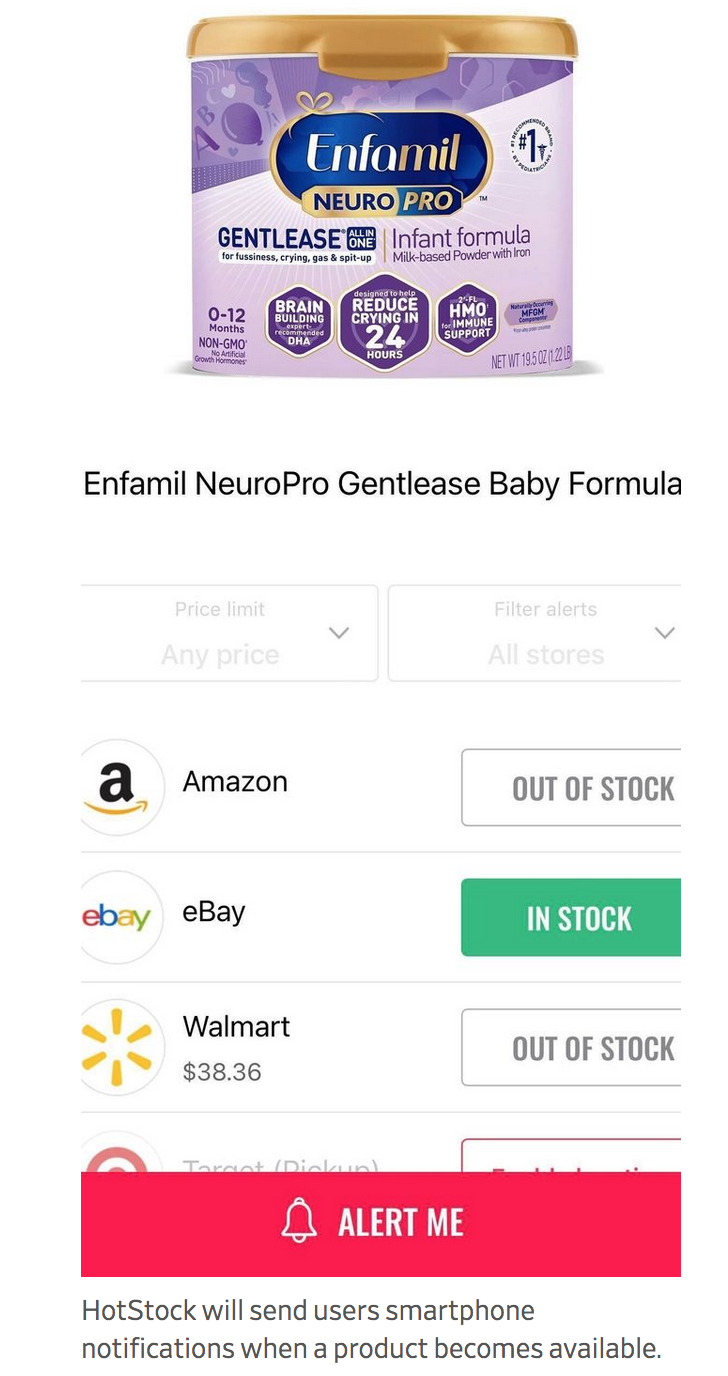
Register For An Account. To receive alerts from NowInStock, ZooLert and HotStock, you’ll need to sign up and tell the service which product you’re interested in. If you don’t register, you’ll have to leave a tracker’s webpage open on your browser and keep checking back for any changes. (Some services offer paid subscription features such as faster notifications.)
Create Accounts With Baby-Formula Retailers. The checkout process will go faster if the retailer already has your address and payment information stored. You can also use your browser’s autofill feature to quickly input your name and shipping information.
Choose Your Notification Type. ZooLert and NowInStock can send you an email or browser alert. (After you sign up, add the company’s email to your address book so messages won’t end up in spam.) The HotStock app can send push notifications to your phone.
Turn On Your Notifications. Make sure your smartphone or computer isn’t in Do Not Disturb mode. Turn up the volume so you can hear an alert. Also, make sure you don’t have your phone’s low-power battery-saver mode turned on because it can slow down notifications.
Be Patient. The tech isn’t failproof. You might not get formula the first (or second) time you try—either because other people moved faster, or because a bug sent a false alert. But they may save you time since you won’t have to keep refreshing each retailer’s website, just hoping that your formula shows up as available.
Biden Invokes The Defense Production Act To Increase Baby-Formula Supply
The administration is also authorizing flights to import baby formula from overseas.
The Biden administration is invoking the Defense Production Act to increase production of baby formula and launching a program that would use commercial aircraft to pick up overseas formula that meets U.S. standards, the White House said Wednesday.
Under the Korean War-era national security mobilization law, President Biden is requiring suppliers to prioritize giving resources to U.S. formula manufactures.
A new program called Operation Fly Formula would also direct the Defense Department to use its contracts with commercial air-cargo lines to pick up formula from other countries that meets U.S. health and safety standards. The White House didn’t specify any countries.
“Imports of baby formula will serve as a bridge to this ramped up production, therefore, I am requesting you take all appropriate measures available to get additional safe formula into the country immediately,” Mr. Biden said in a letter to Health and Human Services Secretary Xavier Becerra and Agriculture Secretary Tom Vilsack.
Last week, then-White House press secretary Jen Psakiplayed down the possibility that the U.S. could invoke the Defense Production Act to boost production of infant formula in the short term.
“The production of baby formula is so specialized and so specific, that you can’t say to a company that produces something else: Produce baby formula,” she said.
The White House has come under pressure in recent days to address a baby-formula shortage that was caused by a mix of supply-chain issues and a recall, which led to empty shelves at some stores, product restrictions and panic among parents and caregivers searching for formula to feed babies.
The White House’s moves are a positive step but won’t solve the problem overnight, said Kristin Rowe-Finkbeiner, executive director of MomsRising Together, an advocacy group for mothers and families. “The situation right now is alarming and too many moms, and especially those with children who have special needs, are struggling,” she said.
Charlie Hartig, chief executive of Hartig Drug Stores, said he expects larger national chains to be given priority to formula because of their logistics capabilities when the U.S. secures more products, with regional and smaller retailers like his receiving supplies later, as they did with other items earlier in the pandemic. Iowa-based Hartig has been trying to secure formula from various suppliers, he said.
Earlier this week, U.S. health regulators took steps to allow more foreign baby formula on American shelves, easing rules that had effectively prevented shipments from many overseas manufacturers. The Food and Drug Administration on Monday said it encouraged the overseas manufacturers to apply to ship their formula to the U.S.
Even with the change in rules, an FDA official said it could be weeks before the products arrive at U.S. store shelves. Manufacturers will first have to apply with the agency to be able to ship their products to the U.S., and then the agency will have to conduct a review to assure quality control and safety.
Later on Wednesday, the House passed legislation largely along party lines to give the FDA $28 million, which Democratic supporters of the bill said would enable the agency to hire staff to ensure the quality of new infant formula.
The House also overwhelmingly approved a separate bill that would allow people buying formula through the federally funded WIC program to switch brands during shortages.
Currently, states may obtain waivers enabling recipients to buy off-contract formula, but the process isn’t automatic during emergency periods. WIC is administered by the states, providing food assistance to pregnant and postpartum women and young children, subject to income caps.
Supplies of baby formula have been running low since late 2021, and shortages deepened after Abbott Laboratories, which makes Similac baby formula, in February halted production at its biggest factory while food-safety regulators investigated possible contamination.
Reckitt Benckiser Group PLC, maker of Enfamil products, has dealt with pandemic-driven shipment and transport delays, while smaller formula brands have been limited on how much they are able to increase production.
Abbott said Monday it had reached an agreement with the FDA to reopen the Sturgis, Mich., plant, and the company has said it is working to boost production of Similac at other facilities, while flying in some formula from Europe.
Reckitt is running plants seven days a week to produce more Enfamil, the company has said, and Gerber parent Nestlé SA has said it would bring in extra formula by plane from Switzerland and the Netherlands.
Administration officials previously said the White House had been working with Abbott and the three other formula makers to identify transportation, logistical and supplier hurdles to increasing production of formula at their U.S. and FDA-approved facilities.
The FDA on March 1 asked some retailers to limit customers’ formula purchases, and Walmart Inc., Target Corp., Kroger Co. and other retailers have implemented buying limits in stores and online. As of early May, about 21% of powdered baby formula was out of stock in U.S. stores, research firm IRI estimated.
Some retailers have sought alternate supplies, though with limited success. Some supermarket operators have tried to use store brands to fill the gaps, though those supplies have run short as well. Doctors and consumer groups have said buying limits prompted some consumers to buy as much as they could, making shortages worse, while resellers have purchased formula to sell online.
Updated: 5-19-2022
Baby-Formula Shortage Leaves Families Desperate, Prompting WIC Program Revamp
Families reliant on multibillion-dollar federal program say they have few alternatives as supplies of approved formulas run out.
A nationwide baby-formula shortage has exposed the shortcomings of a multibillion-dollar government program aimed at providing formula at no cost to families, said lawmakers and recipients, prompting efforts to revamp it.
Some low-income parents who rely on the federal Women, Infants and Children program said that shortages of approved baby formula have left them paying hundreds of dollars to purchase formula outside the program, while they navigate a patchwork of changes made to the WIC program in recent months in response to shortages.
U.S. baby-formula makers and lawmakers are working to resolve a formula crisis that has deepened in recent weeks. A February recall of Similac powdered infant formulas left grocery shelves largely bare in many states where that brand was dominant.
Other manufacturers, such as Enfamil supplier Reckitt Benckiser Group PLC, haven’t been able to make up the difference after Similac’s owner, Abbott Laboratories, paused production at the factory that made the recalled formula.
President Biden said Wednesday that he is requiring suppliers to send ingredients to infant-formula makers before other customers, invoking the Defense Production Act. The White House also directed government agencies to use Department of Defense commercial aircraft to pick up from overseas infant formula that meets U.S. standards.
Government officials have said the shortage is especially acute for families who rely on subsidies from the government’s WIC program, which provides food and health assistance.
Under WIC, which is federally funded but administered by the states, each state contracts with a single infant formula manufacturer to supply the program at a discount, and WIC recipients aren’t able to switch to a different brand if the state-contracted provider’s brand is sold out.
Michelle Richter, 35, receives WIC baby-formula vouchers for her 9-month-old son. In Nebraska, where she lives, she said she hasn’t been able to find formula at WIC-approved retailers even after the program added more brands and sizes.
As a result, Ms. Richter said, she has had to shop online for formula with her own money. Over the past month, Ms. Richter said, she ordered three cans of Enfamil formula for about $150 total from Amazon.com Inc.
“My mother has been helping a lot,” Ms. Richter said. “My boss actually gave me money to buy a can. I’ve had help here and there.”
About 21% of powdered baby formula was out of stock in U.S. stores as of early May, according to research firm IRI. More retailers, including Giant Eagle Inc. and Stop & Shop Supermarket LLC, are introducing purchase limits on formula, joining bigger chains such as Kroger Co. and Walgreens Boots Alliance Inc.
Supporting about half of the nation’s infants, WIC is the largest buyer of infant formula in the U.S., making up more than half of annual formula sales, according to the U.S. Department of Agriculture, which oversees the program. Of the $6 billion total program, roughly $1 billion is typically used on infant formula after rebates, according to market research and USDA data.
“Over the last several months, the federal government has worked round the clock to address the production shortfall brought about by the recall…and offer maximum flexibility, information, and support to WIC participants,” USDA officials said in a statement.
In response to the shortage, the USDA began working with states in February to allow WIC recipients to purchase alternative formulas, such as store brands, as well as different sizes or varieties that aren’t normally covered by WIC.
But the USDA said last week that not all states have enacted all of the waivers, which expire in August. The Biden administration last week called on the remaining states to adopt these changes and offered technical assistance to states’ WIC offices.
Abbott has contracts for supplying WIC in 34 states, all of which have adopted the waivers, according to the USDA.
Lawmakers are proposing longer-term changes to the program that would require manufacturers that win state WIC contracts to provide backup plans in the event of a recall, aimed at preventing future shortages.
The Senate passed a bill by unanimous consent Thursday that would allow participants using WIC benefits to purchase alternative brands and give the U.S. Department of Agriculture the ability to automatically waive restrictions that limit how much participants in a food nutrition program can spend on baby formula. The House passed the bill on Wednesday. It will now go to President Biden for his signature.
Historically, the system has created a greater reliance on WIC-approved formula manufacturers by requiring states to contract a single supplier, thus giving the winning company a majority of market share. The program requires retailers to stock more of WIC-approved brands, which leads to greater sales among non-WIC consumers, too.
The arrangement saves states money by incorporating volume discounts. In fiscal 2021, the rebates totaled $1.6 billion, the USDA said. But it leaves the system at risk of a meltdown if one of the few suppliers with these contracts can’t meet demand, lawmakers said.
Erin Harris, nutrition supervisor at Missouri’s Columbia and Boone County program for WIC, said Missouri switched to Abbott as its sole WIC provider from Reckitt Benckiser last year following a contract bidding process.
In response to the recall, Missouri in late February added larger sizes and other brands including Enfamil, Gerber and Parent’s Choice for WIC users, Ms. Harris said, adding that there have been also discussions to include nongrocery retailers such as pharmacies and dollar stores to the program.
“It has helped alleviate some of the crunch,” Ms. Harris said.
In Tennessee, Macie McGill, a WIC recipient, said she has been budgeting around formula for her 7-month-old infant as she pays for extra gas to drive around to secure formula. She said it got easier when WIC approved more products, and said it would have helped if she had learned about the flexibility around sizes sooner.
“I’m scared I’m buying formula with my money,” she said. Her friends and family have been looking for formula on her behalf, Ms. McGill said, and she has enough to last through June, when she plans to start looking for more.
WIC staff in Missouri have been monitoring formula availability on Facebook groups and other online resources, so that families don’t need to drive farther and spend additional money on gas, Ms. Harris said.
In Wisconsin, WIC nutritionists are sharing information on which stores have stock and are calling retailers to find products for families, said Camila Martin, pediatric dietitian at UW Health in Madison, Wis.
Liliana Cardona said she is buying whatever formula she can find near her home in Waterbury, Conn., sometimes purchasing products at stores like Rite Aid not covered by her WIC benefits. She said she has spent about $150 of her own money in one month on formula and is sometimes letting her monthly benefits expire unused.
She said that it has been nerve-racking trying different formulas with her 4-month-old son, and that the shortages have prompted her to try to reproduce breast milk again.
“I’m excited for him to be 6 months [old], so he can start eating solids,” Ms. Cardona said.
Updated: 5-20-2022
US Should Follow The EU Model For Baby Formula
American parents shouldn’t have to turn to Europe for the highest-quality products — nor rely on foreign supplies when their own market is disrupted.
Startup Bobbie introduced its infant formula product in January 2021, the first new brand to be approved for sale in nearly a decade. It was a small operator representing a tiny fraction of the $4 billion US formula market, but when shortages began roiling the industry in recent months, Bobbie offered at least one more option for rattled parents to turn to.
The story of this young company — and this critical moment of disruption — illustrates why innovation is desperately needed in an essential-food industry that’s both antiquated and paralyzed by consolidation.
Bobbie was created in 2018 when Laura Modi, an executive at Airbnb Inc. who had just given birth, found herself dissatisfied with the formula options available in American grocery stores.
Ireland-born and living in San Francisco, Modi found that many of her friends were buying European products off what she calls “the infant formula black market” — via third-party distributors such as EBay and through direct sales between moms meeting in online parent forums.
The EU formula had higher nutritional standards and healthier ingredients, and well-heeled moms were willing to pay a hefty premium to get it — even if it was contraband. EU-produced formula isn’t subject to Food and Drug Administration oversight, and therefore can’t be legally sold in the US.
Modi dived into research and found that US infant formula standards hadn’t (and still haven’t) been meaningfully updated since the Infant Formula Act of 1980. Meanwhile, EU infant formula standards were updated regularly as the science of infant health evolved.
Modi was convinced that the rising generation of young mothers would prefer innovative products over the Similac, Enfamil and Gerber brands that dominate 90% of the market. She quit her job, raised capital ($72 million to date) from investors including Goop CEO Gwyneth Paltrow and actor Laura Dern, and co-founded Bobbie with her Airbnb colleague Sarah Hardy, the startup’s chief operating officer.
Modi and Hardy entered a market struggling with a contradiction: On the one hand, it needs improved nutritional standards and better FDA oversight; on the other, the market needs new players and more competition.
Not only is the US infant formula industry — aka “Big Bottle” — heavily dominated by three aging brands, only seven production facilities have been approved by the FDA to manufacture all the powdered and liquid formulas sold nationwide.
These products are essential to the survival of millions of infants, yet the supply chain is extremely consolidated and therefore vulnerable.
In February, the industry was predictably thrown into chaos when Abbott Laboratories recalled some of its formula brands, including Similac, and shuttered its Michigan production facility to investigate contamination. In one fell swoop, a third of all infant formula products vanished from store shelves.
The challenge going forward for the Biden administration’s FDA is to simultaneously raise its quality standards for infant formula while also encouraging new young players to enter the market. This can be done. The evidence is clear in the European market — in particular in Germany, which has not only the world’s highest nutritional standards for infant formula, but also more available brands and more numerous and distributed production facilities.
The Biden FDA has made important progress in shoring up formula production in the past week, first having reached an agreement with Abbott on a plan to safely re-open its production facility, which should significantly restore product volume in the next two months. The administration has also eased restrictions on foreign imports of infant formula products that until now have not been allowed on American shelves.
On Wednesday, Biden invoked the Defense Production Act to help revive the supply chain for baby formula ingredients and authorized the use of military planes to fly in foreign-made products. Also critical was President Biden’s decision to increase funding to the FDA, a notoriously understaffed agency that had only nine people working to alleviate the infant formula shortage. With the new funding it has been able to hire four more.
But these are stopgap strategies. The agency needs to build long-term solutions to ensure the security of infant formula production in the future.
The administration should permanently allow for the sale of approved foreign-made baby formulas on the US market. It should also require that any company commanding more than 20% of the baby formula market maintain a backup supply of product in case of recall.
When the House Agriculture Appropriations Committee discussed the fiscal year 2023 budget of FDA Commissioner Robert Califf this week, members should have pushed for more significant long-term increases to FDA funding that can help usher in industry-wide reforms.
There’s no question that raising nutritional standards while also guiding new producers through the product approval process will take a substantially funded, better-staffed and more nimble FDA.
Infant formula falls right in the middle of drugs and food on the regulatory spectrum, which means it requires rigorous testing not just for nutritional quality, but for bacterial and heavy-metal contamination, as well as for shelf stability. Moreover — with the exception of Biden’s emergency measures — all infant-formula products sold in the US must be produced domestically.
Modi learned this the hard way: With such limited production capacity in the US, she produced her first run of products in 2018 in Germany, which she later had to recall. She spent another two years retooling her supply chain and working with her manufacturer to produce the formula in Vermont.
Over the last 40 years, scientists have identified the fatty acid DHA as a critical ingredient in infant formula to support infant brain development. In the US, infant formula companies aren’t required to include DHA. Some do include it, but in the EU, you can’t buy an infant formula without a high level of DHA.
The EU also puts a cap on the use of sugars, like corn syrup, and the US does not. All US products should be required to meet higher standards.
There will be a price to pay. Since Bobbie has based its products off the latest 2019 EU standards and established a resilient supply chain, its cost of production is higher than that of the major players, and even of smaller brands: $1.84 an ounce compared with other premium organic products such as Earth’s Best, which sells for $1.48.
The company’s rapid growth so far should allow these costs to come down with economies of scale. Bobbie’s sales reached $18 million in its first year, compared with the $4 million Modi originally projected, just by selling direct to consumers online. In 2022, Modi expects to quadruple that growth.
Bobbie shows there is a path forward in this nearly impenetrable US industry, while also revealing the challenges inherent in redefining an essential food. Both the Biden administration and its critics can learn from this young business to build a strategy to protect infant health while creating the conditions necessary for new players in the industry to succeed.
Why The Baby-Formula Market Is A Mess: Low Competition, High Regulation
The WIC program and regulations tamp down competition, resulting in Similac and Enfamil controlling the bulk of an inflexible, $4 billion U.S. formula market. It cracked when a major factory halted production.
U.S. officials acted this week to ease a nationwide shortage of baby formula. But none of the moves will create immediate relief for parents scrambling to find stocked shelves. And none fully address the underlying flaws of the more than $4 billion U.S. formula industry, in which business and government depend on one another to keep the country supplied.
Baby formula is one of the most tightly regulated food products in the country. That makes the barrier to new entrants high, and few brands have emerged as challengers to Similac and Enfamil, made by Abbott Laboratories and Reckitt Benckiser Group, respectively, since the two entered the market in the 1950s.
Abbott and Reckitt were responsible for roughly 80% of infant and toddler formula sales in the U.S. last year, according to market-research firm Euromonitor.
Regulations also limit international brands from entering the U.S. from other countries.
The federal government is the product’s biggest buyer, via the Women, Infants and Children supplemental nutrition program, which provides formula at no cost to families. The program’s exclusive sales contract system ensures that in each state, one of the major formula brands has the majority of market share.
The result is a marketplace with little competition and little flexibility, making it vulnerable when something goes wrong.
The supply chain for nutrition for our babies “is far more fragile than I think anyone would ever realize,” said Ron Belldegrun, founder and CEO of new formula maker ByHeart.
It took over $40 million and five years to open the company’s infant formula factory, which began production eight weeks ago, he said, and millions more were spent on research and development, clinical studies and a host of other Food and Drug Administration requirements.
Baby formula first became scarce on store shelves in early 2020, as the Covid-19 pandemic and lockdowns disrupted supply chains. Reckitt has faced shipment delays, as well as longer lead times for some raw materials and packaging, according to company officials.
Then, this February, Abbott halted production at its biggest factory—responsible for one-fifth of U.S. formula—and issued a voluntary recall while food-safety regulators investigated a possible deadly contamination.
The company said Monday that it reached an agreement with the FDA to reopen the Sturgis, Mich., plant. But it has said it would take two weeks to restart production, then six to eight weeks after that before new formula would hit store shelves.
On Wednesday, President Biden invoked the Defense Production Act, which will require suppliers to send ingredients to infant-formula makers before other customers.
The White House also directed government agencies to use Department of Defense commercial aircraft to pick up from overseas infant formula that meets U.S. standards.
On Thursday the administration said it had approved the first shipment—equivalent to up to 1.5 million 8-ounce bottles of hypoallergenic formula for children with medical needs—from Switzerland and is working to identify aircraft to fly it to Indiana.
Formula makers and retailers have said it could take months for supplies to fully recover as U.S. manufacturers face limits to ramping up production and challenges remain in getting the formula to the right places.
Katharine Watkins, who lives in Platte Woods, Mo., said she contacted her governor’s office after struggling to find formula for her 10-month-old daughter, Birdie. Birdie threw up after trying new formulas, so Ms. Watkins called her parents for help finding Birdie’s preferred brand, and they called their friends, too.
“I’m grasping at straws,” Ms. Watkins said. “The thought never crossed my mind that I would go to the store and not be able to find formula.”
State Exclusives
The Agriculture Department’s WIC program has deepened the hold that major manufacturers such as Abbott have over formula sales, in effect reducing the number of brands on offer.
About half of the baby formula sold in the U.S. is purchased through the WIC program, according to the Biden administration.
Under the program, which is federally funded but administered by states, states award exclusive sales contracts to a single formula manufacturer in exchange for discounts.
WIC program participants are required to use their vouchers for formula made by the winning manufacturer, dramatically increasing that company’s market share in a given state, while also boosting sales to non-WIC consumers because stores tend to stock and display the WIC brand.
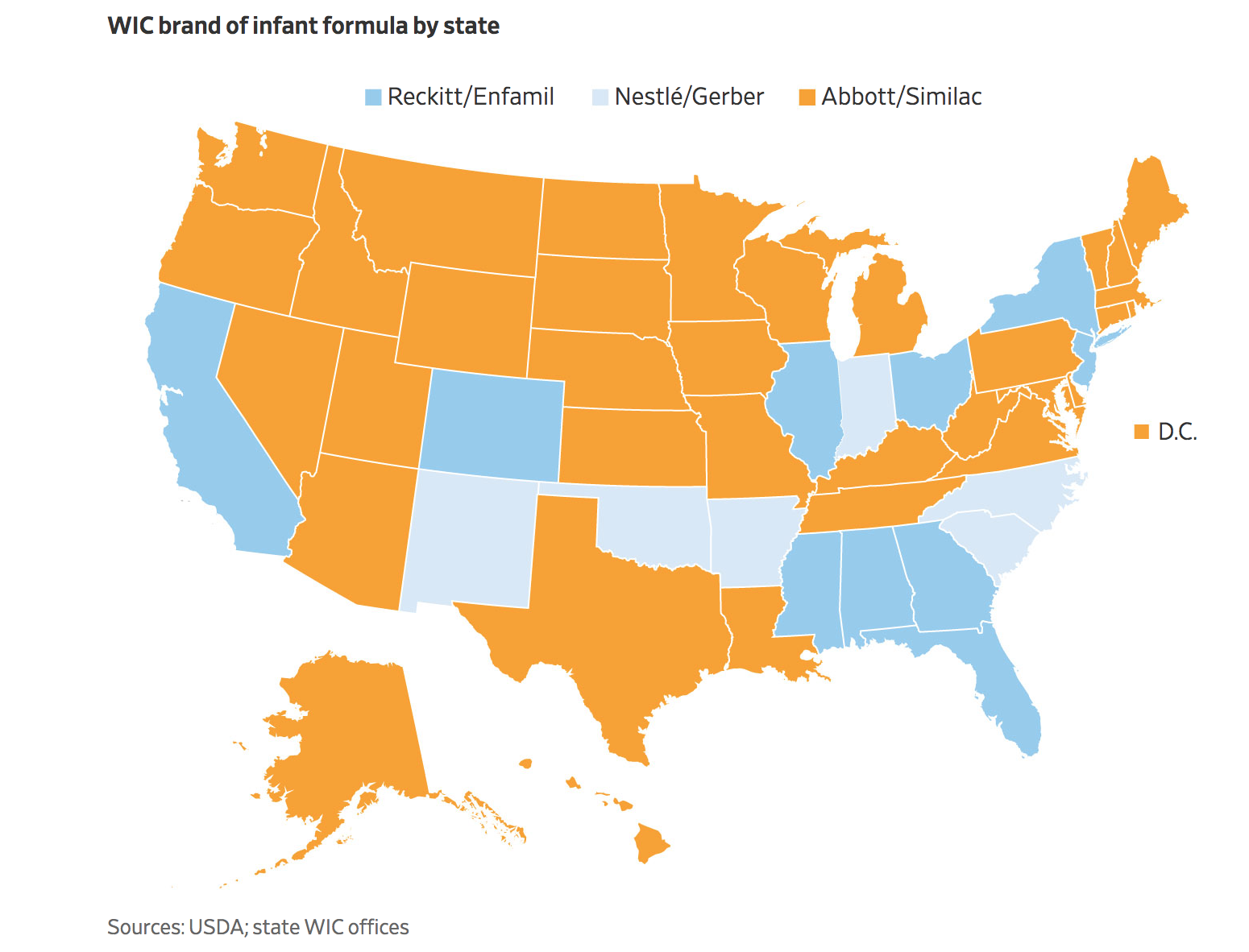
Abbott has contracts with 34 states to supply Similac for WIC, according to the USDA; 10 states work with Reckitt for Enfamil; and six work with Nestlé SA, which makes Gerber products.
Due to the large portion of formula bought by WIC participants, stores offer WIC brands more shelf space and better product placement, according to the USDA. Participating stores are required to keep a minimum amount of the WIC formula brand in stock, and because smaller grocery stores have limited shelf space, those stores may stock the WIC brand exclusively.
Many hospitals have begun mirroring the federal program, contracting with just one formula manufacturer to get bulk discounts, said Steven Abrams, an infant-nutrition expert and professor of pediatrics at Dell Medical School at the University of Texas at Austin.
While WIC’s design helps keep costs down for taxpayers, Dr. Abrams said it can exacerbate shortages in the event of supply-chain problems by offering a single WIC brand dominance in a given state.
Lawmakers have proposed changes to WIC to prevent future shortages, including requiring formula manufacturers to outline in their WIC contracts a contingency plan in the event of supply disruptions.
The legislation, which awaits President Biden’s signature after passing in Congress this week, also gives the USDA expanded, permanent authority to offer waivers for WIC recipients to purchase a wider variety of formulas in a crisis.
Some consumer advocates say Congress and the White House waited too long to act, and that recent measures don’t address the longer-term, structural issues in formula production and infant nutrition.
“This has been a wake-up call to the systemic problems we have,” said Kristin Rowe-Finkbeiner, CEO of MomsRising, an advocacy group for mothers and families.
Government and industry officials say they have been working to alleviate the shortage since February, when the USDA initially allowed for flexibility in the WIC program and manufacturers, including Reckitt and Nestlé, began shipping more formula to fill the gap left by Abbott.
Barriers To New Competition
Beyond Abbott and Reckitt, other companies have had limited success breaking into the baby-formula market. Nestlé had a nearly 10% market share in the U.S. last year, according to Euromonitor, while store brands, such as Target’s or Walmart’s brand, made up about 5% and Danone SA, the owner of Happy Baby products, had a roughly 1% share.
Parents generally don’t switch formulas unless a baby isn’t responding well, and the makers of Similac and Enfamil have decades-old marketing programs that cultivate relationships with healthcare providers and send formula samples to new parents, helping maintain their dominance, doctors said.
A 1980 law governing infant formula established high regulatory hurdles, beyond typical FDA requirements for other foods.
Manufacturers seeking to create new formula brands must submit to the FDA detailed explanations for how their products are developed, studies regarding the nutrients included, details of quality-control measures in the manufacturing facility and more.
The FDA then inspects the facility, observes the production process and collects samples for nutrient and microbiological analyses, the agency said.
The FDA has struggled with a backlog of submissions for new formulas, extending the timeline for approvals, according to consumer advocates. The agency estimates it received 31 applications last year and reviewed 22, according to the FDA’s 2021 budget, which doesn’t indicate if the applications were approved.
Meanwhile, the U.S. formula market has seen less investment than other industries because demand has stagnated, as U.S. birthrates have dropped and rates of breast-feeding have risen in recent decades, said Lyman Stone, director of research for Demographic Intelligence, a forecasting firm that specializes in births and works with formula manufacturers including Abbott and Nestlé.
New entrants in the market have focused largely on specialty formulas, such as those that meet particular dietary, nutritional or medical needs, Mr. Stone said.
John Wallingford, a former formula executive at Wyeth Nutrition and FDA scientist who now consults with formula makers, noted that large formula manufacturers in the U.S. also make higher-profit medical devices and healthcare products.
“Companies that manufacture infant formula have to struggle to get investments for upgrading or building a new facility because they’re competing with dollars that will go to other, higher margin products,” Mr. Wallingford said.
Regulatory hurdles also mean little formula comes into the country from abroad, although the U.S. eased some rules this week. The U.S. typically produces about 98% of formula consumed domestically, according to the FDA.
Some formula is imported from Mexico, Ireland and the Netherlands, the FDA said, though some shipments are subject to strict FDA labeling and other requirements.
Infant formulas typically contain elements of cow’s milk plus vegetable oil and various vitamins and minerals. The American Academy of Pediatrics recommends that infants under about 6 months old consume only breast milk or formula.
The FDA this week said it encouraged overseas manufacturers to apply to ship their formula to the U.S. The agency will conduct a review to assure quality control and safety.
Some U.S. families order European formulas from third-party vendors, though this practice has prompted safety concerns, as U.S. consumers may not be aware if foreign products are recalled. U.S. Customs and Border Protection officers last year seized hundreds of cases of infant formula arriving from Germany and the Netherlands that the government said violated FDA import safety regulations.
Demand Shifts
Formula manufacturers have been particularly hard hit by trucking shortages during the pandemic, said Demographic Intelligence’s Mr. Stone. Because baby formula is a bulky, relatively low-price product by weight, formula makers’ bids for truck space are less competitive than producers of consumer electronics or other goods.
The supply shocks have been intensified by recent shifts in demand for formula, Mr. Stone said. Demand for baby formula has increased in recent months as U.S. birthrates ticked up slightly last year while breast-feeding rates have seemed to decline, he said.
From the start of this year through May 8, U.S. formula sales by volume rose 5.9%, according to market-research firm IRI. For several years leading up to the pandemic, sales volume of formula had been flat or declining. In 2020, it started increasing again, IRI said.
Dr. Abrams said some 80% of U.S. women breast-feed immediately after delivery, but that by the time children reach the age of 1, between 70% and 90% will receive some formula.
The shift is largely driven by social and economic factors including short, unpaid or nonexistent maternity leaves and lack of lactation support, and lower-income women are especially restricted in their choices around breast-feeding.
Specialized formulas for infants and children with severe allergies, intestinal failure or metabolic disorders have been especially constrained during this crisis, said University of Texas’ Dr. Abrams.
The formulas are produced in smaller quantities because they have fewer potential buyers and aren’t big moneymakers for manufacturers. These amino-acid based formulas make up less than 1% of formula sales, according to IRI.
The crisis hit home months ago for Emma Ibrahim, when the specialty formula she feeds her 2-year-old daughter, made by Abbott, disappeared from store shelves. Ms. Ibrahim offered another brand to her daughter, Mariam, who eats through a feeding tube due to a complex intestinal disease.
Mariam responded with vomiting and diarrhea, forcing doctors to boost her dosage of an intravenous food that carries risks of liver damage and infection, Ms. Ibrahim said.
Ms. Ibrahim said she felt she had no choice but to keep feeding her daughter the recalled formula while she waited for approved supplies to be back in stock. “It’s insane. It feels like a dream,” said Ms. Ibrahim, who lives in Chicago. “This is a first-world country. Why did we not have a backup plan?”
Here’s The Latest Ranking By City Of Baby Formula Shortages
Metro areas hardest hit include Nashville for the week ending May 14, with West Texas fairing best.
The number of US cities with severe baby formula shortages increased over the week ending on May 14.
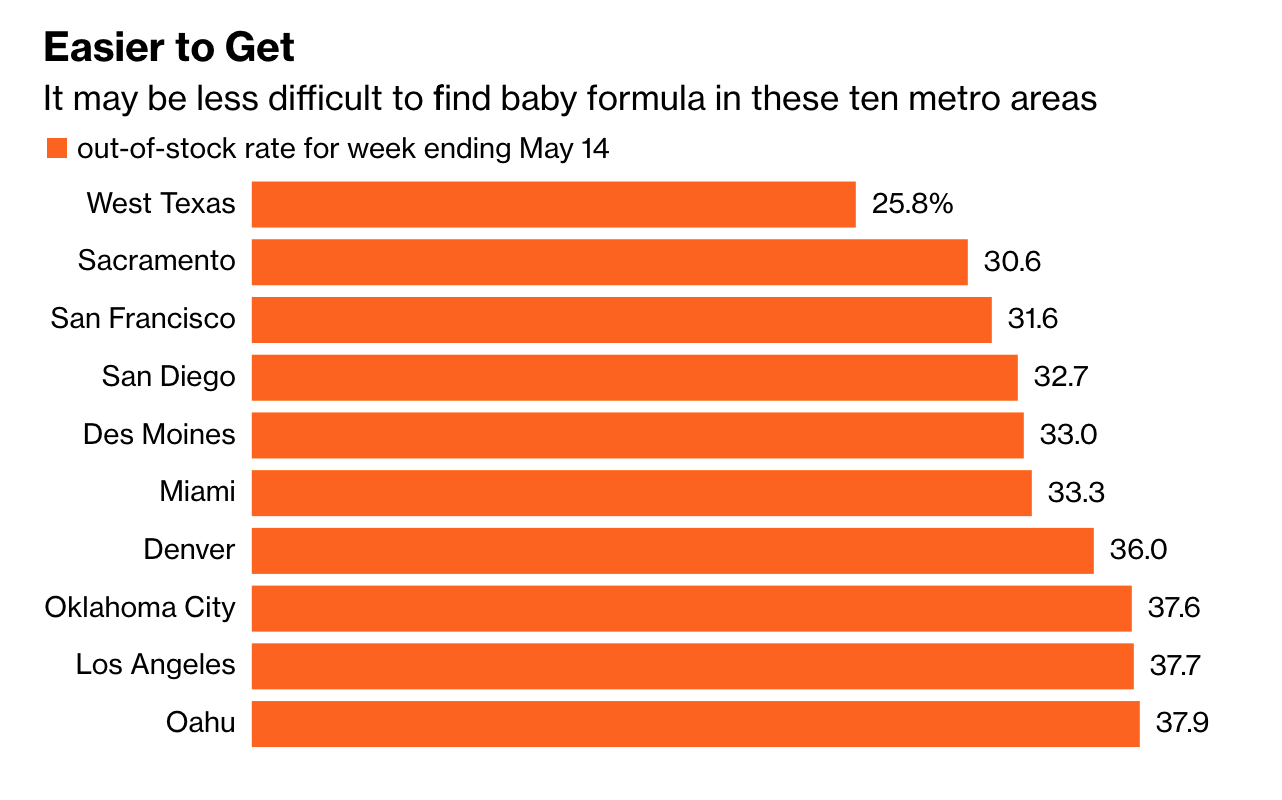
There are now 11 cities with out-of-stock rates above 50% for the week ending May 14, up from eight the week prior. Hardest hit is Nashville, which jumped to over 57% from 52%, according to retail-tracking firm, Datasembly. The best supply is currently in West Texas, which saw a decrease in its out-of-stock rates from 33% to 26%.
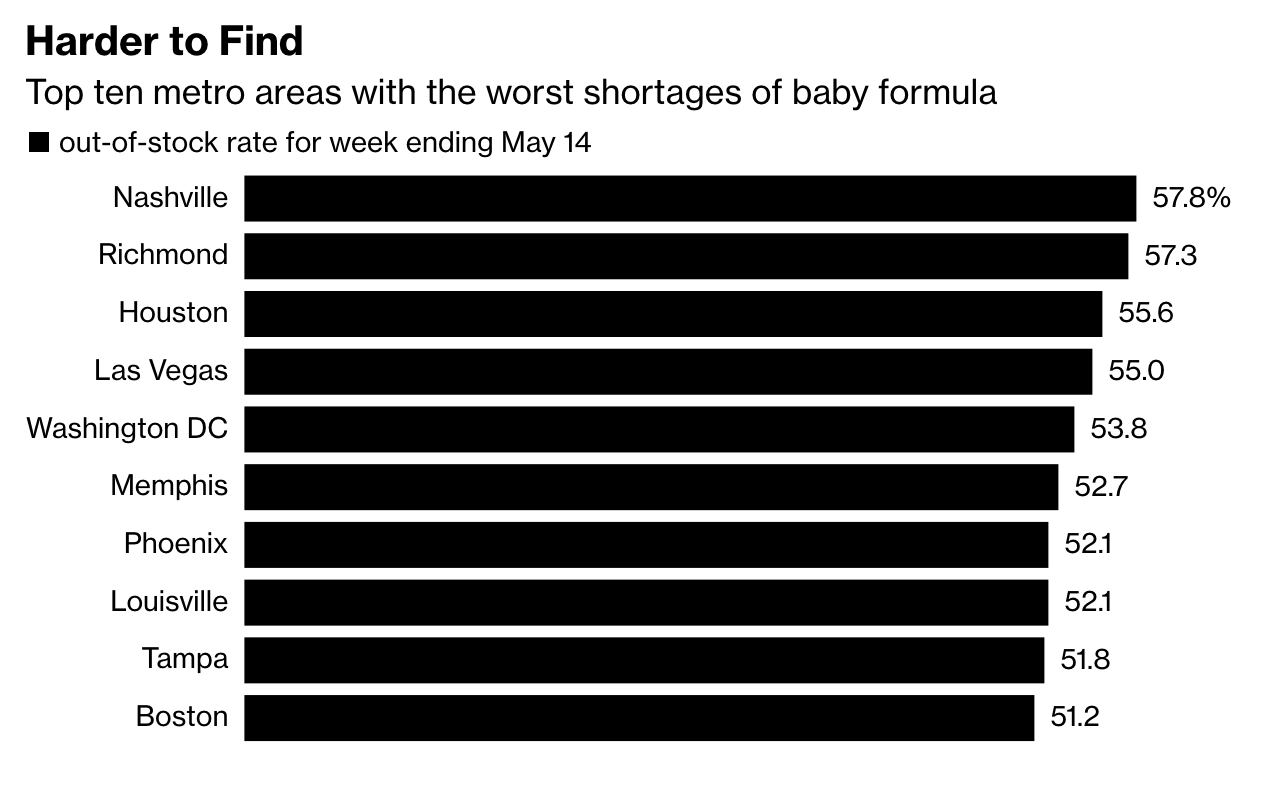
The state with the strongest supply for the week ending May 14 is New Mexico with an out-of-stock rate of 28%, improved from 29% from the prior week. Virginia has the worst out-of-stock rate at 58%, a jump from 49%. Nationally, the out-of-stock rate is now at 45%, according to Datasembly.
The Biden Administration is taking several steps to combat the shortage. On Thursday, the administration announced it had secured from Nestlé S.A. 1.5 million 8-ounce bottles of formula for babies with cow milk allergies.
The formula is being flown on hundreds of pallets from Zurich, Switzerland, to Plainfield, Indiana, on Department of Defense aircraft. This follows President Joe Biden’s announcement on Wednesday of the creation of the Operation Fly Formula program to fly imports in from overseas.
Biden also invoked the Defense Production Act to boost production of baby formula domestically, and is working with the Food and Drug Administration to reopen Abbott Nutrition’s facility in Sturgis, Michigan, which closed in February due to an investigation of possible contamination of some of the company’s powdered infant products.
On Thursday, Congress passed a bipartisan bill, the Access to Baby Formula Act, that requires baby formula manufacturers to prepare for future shortfalls and removes barriers to families purchasing formula on the Special Supplemental Nutrition Program for Women, Infants and Children, or WIC, program.
Updated: 5-22-2022
Abbott CEO Apologizes For Company’s Role In Baby Formula Shortage
Robert Ford says in op-ed that production would ramp up in June; First overseas shipments from Biden’s Operation Fly Formula arriving in U.S.
Abbott Laboratories Chief Executive Robert Ford apologized Saturday for his company’s role in the nationwide shortage of baby formula and promised production will ramp up again in June.
“We’re sorry to every family we’ve let down,” Mr. Ford wrote in a Washington Post op-ed.
Mr. Ford explained what led to his company’s voluntary recall of baby formula and detailed the company’s plan to avoid a similar shortage in the future.
“We are making significant investments to ensure this never happens again,” he wrote.
In February, Abbott Laboratories voluntarily recalled some of its Similac, Alimentum and EleCare formulas manufactured in its Sturgis, Mich., plant after Food and Drug Administration officials found a potentially deadly bacteria there.
That decision exacerbated an existing baby formula shortage created by supply-chain issues during the Covid-19 pandemic, Mr. Ford acknowledged.
“We take great pride in manufacturing nutrition and formula to feed America’s infants, including our most vulnerable,” Mr. Ford said.
Four infants who drank tainted baby formula were hospitalized and two of them died, however the FDA said the bacteria didn’t match the strains found at the Abbott plant.
Nonetheless, Mr. Ford wrote, issuing a voluntary recall was the right thing to do.
“The FDA’s investigation did discover a bacteria in our plant that we will not tolerate. I have high expectations of this company, and we fell short of them,” he wrote. “We will not take risks when it comes to the health of children.”
The shortage has led to empty shelves at some stores, product restrictions and panic among parents and caregivers searching for formula to feed their babies.
President Biden on Wednesday invoked the Defense Production Act to increase production of baby formula and launched a program—called Operation Fly Formula—that would bring supplies by cargo plane that meets U.S. standards from overseas.
On Sunday, Mr. Biden tweeted photos of the aircraft being loaded with supplies.
“Our team is working around the clock to get safe formula to everyone who needs it,” Mr. Biden wrote on Twitter, moments before the first formula shipment arrived in Indiana Sunday.
Mr. Biden also said Sunday that Operation Fly Formula secured a second flight to transport Nestlé SA specialty infant formula to Pennsylvania.
A top White House official on Sunday defended the administration’s approach to the shortage and blamed longer-term trends for the crisis.
‘We are making significant investments to ensure this never happens again,’ Abbott CEO Robert Ford said in an op-ed on the nationwide baby formula shortage.
Abbott LaboratoriesChief Executive Robert Ford apologized Saturday for his company’s role in the nationwide shortage of baby formula and promised production will ramp up again in June.
“We’re sorry to every family we’ve let down,” Mr. Ford wrote in a Washington Post op-ed.
Mr. Ford explained what led to his company’s voluntary recall of baby formula and detailed the company’s plan to avoid a similar shortage in the future.
“We are making significant investments to ensure this never happens again,” he wrote.
In February, Abbott Laboratories voluntarily recalled some of its Similac, Alimentum and EleCare formulas manufactured in its Sturgis, Mich., plant after Food and Drug Administration officials found a potentially deadly bacteria there.
That decision exacerbated an existing baby formula shortage created by supply-chain issues during the Covid-19 pandemic, Mr. Ford acknowledged.
“We take great pride in manufacturing nutrition and formula to feed America’s infants, including our most vulnerable,” Mr. Ford said.
Four infants who drank tainted baby formula were hospitalized and two of them died, however the FDA said the bacteria didn’t match the strains found at the Abbott plant.
Nonetheless, Mr. Ford wrote, issuing a voluntary recall was the right thing to do.
“The FDA’s investigation did discover a bacteria in our plant that we will not tolerate. I have high expectations of this company, and we fell short of them,” he wrote. “We will not take risks when it comes to the health of children.”
The shortage has led to empty shelves at some stores, product restrictions and panic among parents and caregivers searching for formula to feed their babies.
President Biden on Wednesday invoked the Defense Production Act to increase production of baby formula and launched a program—called Operation Fly Formula—that would bring supplies by cargo plane that meets U.S. standards from overseas.
On Sunday, Mr. Biden tweeted photos of the aircraft being loaded with supplies.
Loading tweet…
“Our team is working around the clock to get safe formula to everyone who needs it,” Mr. Biden wrote on Twitter, moments before the first formula shipment arrived in Indiana Sunday.
Mr. Biden also said Sunday that Operation Fly Formula secured a second flight to transport Nestlé SA specialty infant formula to Pennsylvania.
A top White House official on Sunday defended the administration’s approach to the shortage and blamed longer-term trends for the crisis.
“How did we end up in a market where we have three companies that control 90% of the market?” the director of the White House National Economic Council, Brian Deese, said on CNN’s “State of the Union,” adding that officials were weighing steps to open up that market to more competition.
“We’re going to have to work on that,” Mr. Deese said.
Mr. Deese also said that the first shipment of formula brought to Indiana from Germany accounted for around 15% of the national need, and that he expected additional such flights early this week.
“We’re going to keep ramping that up until we get there,” he said.
Abbott’s Mr. Ford said the company plans to restart its Sturgis facility in early June after entering into a consent decree with the FDA. It will take six to eight weeks from when production begins to get products on the shelves.
“When we are operating our Michigan facility at full capacity, we will more than double our current production of powdered infant formula for the United States,” he wrote. “By the end of June, we will be supplying more formula to Americans than we were in January before the recall.”
Meanwhile, he said, the company is putting baby formula production ahead of all its other adult products at its Ohio plant and has flown in supplies from its facility in Ireland.
Specialized baby formula known as EleCare, for infants or children who can’t digest other formulas and milks, is the priority, Mr. Ford said.
“Given their unique needs, children who lose access to it can require medical supervision until the formula is returned to the shelves,” he wrote.
Consumers can feel safe buying Abbott Laboratories products currently in stores, Mr. Ford said.
“What is available has passed rigorous inspections and is ready for your babies,” he said.
US Gets First 70,000 Pounds Of Baby Formula To Ease Shortage
* Military Plane Touches Down In Indianapolis After Biden Order
* White House Says Product To Be In Stores As Early As This Week
A planeload of more than 70,000 pounds (32 metric tons) of baby formula arrived in the US, starting an emergency program to alleviate a national shortage that has left some parents scrounging to feed their children.
More formula will start arriving in stores “as early as this week,” Brian Deese, President Joe Biden’s top economic adviser in the White House, said on CNN’s “State of the Union.” The plane that landed in Indianapolis on Sunday will address “15% of the overall national volume that we need,” he said.
Faced with pressure by Republicans and Democrats to address the crisis, Biden last week ordered the use of government planes to airlift infant formula to the world’s richest country. He also invoked emergency powers under the Defense Production Act to spur domestic manufacturing.
The US Air Force cargo plane from Ramstein Air Base in Germany delivered 132 pallets of Nestlé Health Science Alfamino Infant and Alfamino Junior formula. A second flight of Nestlé formula for children with cow’s milk protein allergy will depart Ramstein for Pennsylvania in the coming days, the White House said in a statement.
I’m in Indianapolis, where the first shipment of formula brought to the United States under Operation Fly Formula arrived this morning. This shipment of formula serves a critical medical purpose and will help infants with specific dietary needs requiring specialized formula. pic.twitter.com/BIrTfSo0X5
— Secretary Tom Vilsack (@SecVilsack) May 22, 2022
Supply-chain snarls that reduced formula availability across the US turned into a full-blown crisis in February when Abbott Laboratories, the largest supplier of powdered infant formula, issued a voluntary recall and closed a plant after four infants fell ill.
“Our team is working around the clock to get safe formula to everyone who needs it,” Biden wrote on Twitter on Sunday.
Deese said the shortage highlights how few companies are making baby formula.
“How did we end up in a market where we have three companies that control 90% of the market?” he said. “It goes back to this question of how we can bring more competition in our economy, have more providers of this formula, so that no individual company has this much control over supply chains.”
Congress last week passed a bipartisan bill, the Access to Baby Formula Act, that requires baby formula manufacturers to prepare for future shortfalls and removes barriers to families purchasing formula on the Special Supplemental Nutrition Program for Women, Infants and Children, or WIC, program.
I have an update on Operation Fly Formula. We have secured a second flight to transport Nestlé specialty infant formula to Pennsylvania.
The flight and trucking will take place in the coming days, and I will continue to keep you updated.
— President Biden (@POTUS) May 22, 2022
Abbott Chief Executive Officer Robert Ford apologized for worsening the shortage in a column for the Washington Post and said the company will make “significant investments” to prevent a recurrence. Available data didn’t find evidence that Abbott products caused the illnesses, he said.
Meanwhile, desperate parents have turned to the internet for solutions and alternatives. Medical experts warn that homemade versions of baby formula come with serious health risks.
FDA Says Senior Officials Didn’t Receive Infant Formula Whistleblower Report Due To ‘Mailroom Issues’
The FDA’s top official will acknowledge a string of failures that contributed to the current infant formula shortages when he faces lawmakers on Capitol Hill on Wednesday.
In their prepared testimony released Tuesday evening, FDA Commissioner Robert Califf and several senior officials for the first time lay out a timeline of the agency’s response to reports last fall that infants had been hospitalized after consuming formula made at an Abbott Nutrition plant in Sturgis, Mich.
And they say a whistleblower report alleging food safety problems at the plant, which was mailed in October, did not reach the FDA’s highest rungs until mid-February, despite being sent directly to then-acting Commissioner Janet Woodcock and others.
The Abbott plant was temporarily shut down in February, after an FDA inspection in January found five different strains of a potentially deadly bacteria known as Cronobacter sakazakii, the bacteria that sickened the four infants.
Two of those infants died. At the same time, Abbott also issued a recall of some formula made at the plant, exacerbating a shortage of infant formula that began during the pandemic.
The FDA now finds itself at the center of a political firestorm over the shortages, which have sent parents scrambling for alternative sources. The need is particularly acute for infants and children who rely on specialty formulas due to health conditions — a growing number of infants with special dietary needs have been hospitalized.
Up until now, however, FDA officials declined to comment on why it took months between the first report of a bacterial infection linked to the plant last September, their inspection this winter, which turned up a range of food safety problems, and the recall.
But the new details aren’t likely to tamp down the criticism of the agency, rather, they are already fueling further outrage from lawmakers.
“The FDA, at every step of this process, dropped the ball,” Rep. Rosa DeLauro (D-Conn.), chair of the House Appropriations Committee, told POLITICO in an interview about the new details revealed in the testimony. “It put infants at risk.”
The FDA timeline laid out in the prepared testimony acknowledges the FDA didn’t hold interagency discussions about potential supply chain disruptions until Feb. 14, three days before the Abbott Nutrition plant at the center of the current shortages shut down and issued a formula recall.
And the agency didn’t notify the Agriculture Department, which oversees a critical federal nutrition program that purchases about half of the nation’s infant formula, about potential disruptions until a week before the Abbott plant shut down.
The program, known as WIC, serves 1.2 million infants from low-income families. Abbott supplies nearly half of all infant formula provided through WIC state contracts.
The testimony also blames “mailroom issues” for the fact that senior FDA officials, including Woodcock and FDA’s top food safety official, Susan Mayne, did not receive hard copies of the whistleblower report from last October detailing alarming concerns about the Abbott plant, including poor food safety practices and that officials there had falsified documents and intentionally information from FDA inspectors. The FDA did not interview the whistleblower until December.
According to Califf’s testimony, Woodcock and Mayne eventually received the whistleblower report via email from another FDA staffer on Feb. 14, three days before the recall.
The agency says copies of the whistleblower report sent to Mayne and another FDA official were found in the FDA’s mailroom in May, but officials have yet to locate the copy sent to Woodcock. It was “likely due to COVID-19 staffing issues” and “a mailroom analysis is underway,” the prepared remarks state.
The FDA timeline does say other FDA officials overseeing infant formula and regulatory affairs received a copy of the 34-page report last October.
Mayne and Frank Yiannas, FDA’s deputy commissioner for food policy and response, will testify alongside Califf on Wednesday. As POLITICO has reported, Mayne and Yiannas do not get along and it’s created tension at the senior levels of an agency already struggling to make decisions.
But Woodcock, whom Califf assigned to help oversee the agency’s food divisions in the midst of the formula fallout, will not appear before the committee.
Senior leaders at Abbott and two other major formula manufacturers will also testify before Congress on Wednesday.
DeLauro was not satisfied with the agency’s explanation for its slow response to the whistleblower report. “Take responsibility.
If you are the director, if you are the acting director, then you have to know what the hell is going on,” said DeLauro, who has criticized the FDA for allowing Woodcock to also lead the internal review of its response.
“Who told staff that they could interview the whistleblower? You know what, let me step back a second, who’s in charge?” DeLauro added.
Califf’s testimony also addresses why it took the FDA until the end of January to begin its inspection of Abbott’s Sturgis plant, despite receiving warnings last fall.
For several months after the initial reports of bacterial infections, Califf says the FDA struggled to match formula samples to the specific bacterium, which is known to grow in infant formula and cause rare but potentially fatal illnesses in babies. A Covid-19 outbreak among the plant’s staff in early January further pushed back the inspection’s launch.
When the FDA’s inspection team finally entered the plant on Jan. 31, they “observed significant operational deficiencies,” according to the testimony.
“The totality of evidence obtained during our inspection caused FDA to conclude that infant formulas produced at this plant were produced under insanitary conditions and may be contaminated with Cronobacter,” the testimony says.
When the FDA got back positive samples of Cronobacter from the January inspection, Califf says they alerted Abbott and told the company it should issue a recall.
Despite the delays detailed in the timeline, the testimony argues that FDA “since the first day…has worked tirelessly with U.S. government partners to mitigate the supply chain disruption for both regular and specialty formulas.”
But lawmakers have questioned why it wasn’t until May 16 that the FDA and Abbott agreed on a deal to reopen the Sturgis plant.
White House and USDA officials have privately complained about the FDA’s decision not to warn other parts of the administration earlier, while allowing the situation to grow into a food security crisis for American families and a political crisis for President Joe Biden, just months ahead of the November midterms.
The White House has also ducked questions about its own timeline in responding to the recall and ensuing shortages. Asked by POLITICO about when the FDA told the White House of the issues at the Sturgis plant and any concerns about potential shortages, a senior administration official said they would not comment on “internal communications.”
“The recall became public on February 17 and we certainly have been very public about our activity in this space since then,” the official added.
Updated: 5-25-2022
FDA Chief Takes Aim At Abbott Laboratories As He Signals Potential Reforms To Food Safety Division
The commissioner said the division needs a ‘stronger team at the high levels,’ as part of a revamping of the entire food program.
U.S. Food and Drug Administration Commissioner Robert Califf signaled potential reforms to his agency’s food safety division, even as he took aim at “shocking” safety lapses at Abbott Laboratories’ Michigan baby formula plant.
In a five-hour hearing before congressional lawmakers Wednesday, Mr. Califf blamed outdated technology and coordination breakdowns for delays in responding to warnings about infant formula safety. He also indicated the food division of the agency needed new leadership.
“These problems that we’re describing are systemic and they weren’t fixed,” he said. “We definitely need a stronger team at the high levels on the food side as part of a revamping of the entire food program.”
Mr. Califf said his agency was too slow to respond to a whistleblower report about safety failures at the Abbott manufacturing plant in Sturgis, Mich., which exacerbated infant formula shortages when it was shut down.
The report, released last month by Rep. Rosa DeLauro (D., Conn.), alleged a long list of safety lapses at the Sturgis facility, including the release of untested formula. An FDA inspection earlier this year also found problems at the plant, including the presence of dangerous bacteria and standing water on the floor.
“Frankly the inspection results were shocking,” Mr. Califf said, comparing the conditions in Abbott’s plant to a muddy kitchen. “We had no confidence in the integrity of the Abbott quality program at this facility.”
But Mr. Califf said he met with Abbott executives Tuesday and was sure they were taking careful steps to reopen the facility by the first week of June.
Mr. Califf testified before the House Energy and Commerce Committee’s oversight and investigations subcommittee about the closure of the plant and the attempts to address the short supply. The Energy and Commerce panel oversees the FDA, which regulates baby formula.
The FDA’s discovery of bacteria at the plant prompted Abbott in February to recall some products and shut down the plant.
Christopher Calamari, Abbott’s senior vice president for U.S. nutrition, told lawmakers his company wasn’t aware of the whistleblower complaint until it was made public by Congress in April. He said his company’s policy is to encourage employees to report safety problems.
“The whistleblower allegations—we don’t know them to be true. That’s an open investigation, and it’s ongoing,” Mr. Calamari said. “What I can tell you is that I was at Sturgis last week, and the employees I saw are committed to the highest quality.”
Mr. Califf defended his agency’s handling of the formula shortages that followed the plant closure, but said that the agency needs more data from industry to be able to prevent and prepare for future shortages.
“The industry has fought us tooth and nail in requiring that there be insight into their supply chains,” Mr. Califf said.
Lawmakers in the hearing expressed dismay at the FDA’s slow response to safety warnings at the Abbott plant and inability to alleviate shortages more quickly.
“I’m actually pretty furious about the FDA’s lack of food safety leadership,” said Rep. Jan Schakowsky (D., Ill.).
Rep. Larry Bucshon (R., Ind.) said he can see both parties in Congress backing a move to give the FDA more authority over supply chains. “With the pandemic, we’re going to have a lot more interest, with Congress and supply chains, not only in this area, but everywhere,” he said.
Abbott, Reckitt Benckiser Group and Nestle SA produce most of the formula sold in the U.S.
The hearing is the latest in Congress on the short supplies of a crucial baby product, which have left some store shelves empty, triggered an outcry from parents and prompted the Biden administration to try to address the problem.
Some families rely on formula to feed and provide nutrition to their babies. Stocks started running short in 2020 after the Covid-19 pandemic disrupted supply chains.
Starting last year, four infants were hospitalized with cronobacter bacteria infections after consuming Abbott formula, and two died. Abbott has denied that the cronobacter infections were caused by contamination at its plant.
The Centers for Disease Control and Prevention said genetic testing on the bacteria strains in two of the hospitalized infants didn’t match the bacteria discovered at the plant. This month, Abbott reached agreement with the FDA on the steps needed to reopen the company’s Michigan plant under agency supervision.
Formula makers have said it could take months to eliminate the shortages. Meanwhile, the White House has arranged for Defense Department commercial aircraft to fly in formula that meets U.S. standards from overseas.
The Biden administration also said it would use the Defense Production Act to make sure formula makers have the ingredients they need to increase production.
Also, the FDA temporarily eased baby-formula import rules to permit the distribution of more products to the U.S.
Updated: 5-26-2022
National Baby-Formula Stockpile Is Urged by FDA Commissioner
Agency head says he expects a surplus of formula in about two months because of government, company efforts.
Food and Drug Administration Commissioner Robert Califf proposed a national stockpile of baby formula that authorities could tap to ease future shortages.
Dr. Califf said in a hearing Thursday before the Senate Health, Education, Labor and Pensions Committee that he expects recent government and private sector moves will produce a surplus of formula in about two months.
“The question is should we maintain that surplus as a government activity for the foreseeable future,” he said.
To be prepared for shortages or other emergencies, the U.S. maintains strategic stockpiles including for petroleum and antibiotics.
Dr. Califf didn’t discuss the specifics of stockpiling formula, which even if unopened, eventually expires. National stockpiles for medical products, in particular, are regularly monitored to make sure they remain stable and could be used if needed.
Republicans and Democrats on the committee criticized the pace of FDA’s inspection process and response to a whistleblower report about safety lapses in the Michigan factory where Abbott Laboratories makes a large share of its baby formula.
“Complacency is apparently the FDA’s catchphrase when it comes to infant formula,” said Sen. Richard Burr (R., N.C.).
Dr. Califf said his agency was too slow to respond to safety warnings, and he promised reform. “There are systemic issues within FDA and in our interactions with the industry,” he said.
Abbott voluntarily closed its Sturgis, Mich., facility in February after FDA inspectors found bacterial contamination and other violations, worsening formula shortages that began earlier in the year due to supply chain issues.
Company officials have said they expect the plant to reopen June 4.
Meantime, the Biden administration has arranged shipments of formula from overseas, loosened import regulations and invoked the Defense Production Act to speed supplies to manufacturers in the U.S.
Abbott, Nestle SA and Reckitt Benckiser Group produce most of the formula sold in the U.S. The formula makers told House lawmakers Wednesday that they have stepped up production and will try to do so more.
Updated: 5-28-2022
Baby-Formula Shipments Come With High Security To Deter Cargo Thieves
Logistics companies are using tracking technology and special locks to protect deliveries of infant formula from criminals.
Efforts to rush baby formula to depleted U.S. stores are triggering a range of security steps aimed at protecting the shipments from potential theft, logistics security experts said, including measures normally taken when moving pharmaceuticals and electronics.
The precautions range from paying special attention to who is handling and transporting the formula to adding tracking technology and special locks. Security experts said these procedures have been used for years in protecting goods from semiconductors to household staples that have been targeted by cargo thieves.
Baby formula has long been attractive to criminals, along with other food and beverages, a category that was the No. 1 theft target from 2010 to 2020, according to cargo-security experts. Food and drinks overtook electronics as the most popular target for cargo thieves in the aftermath of the 2007-09 financial crisis, when household incomes dived and staples were in high demand, cargo-security executives said.
The shortage in infant formula across the U.S., caused by a mix of supply-chain issues and a recall, has made the product an even bigger target for cargo thieves, as panicked parents and caregivers search for formula to feed their babies.
“Anytime we see a situation with a high-value cargo where there is the scarcity we are experiencing now, that concerns us,” said Zak Bowyer, vice president of sales support operations at Total Quality Logistics, a Cincinnati-based freight broker whose customers include makers of infant formula.
For Total Quality Logistics, which contracts with independent drivers to handle shipments, the enhanced measures range from what Mr. Bowyer calls “extreme vetting” of carriers to physical security such as special locks on trailers and tracking systems embedded in the shipments.
“We would move it with the same security that we apply to pharmaceuticals and electronics and other shipments that may be targeted,” he said.
A can of baby formula might cost far less than an iPhone, but experts say food-and-beverage shipments can be easily resold, are hard to trace, and can be held over time and shipped over long distances without spoiling. The products are later consumed, leaving no evidence behind.
“Infant formula, the Enfamil, Similac and the others, has always been at high risk for theft,” said Keith Lewis, vice president of operations at CargoNet, a logistics-security unit of Verisk Analytics Inc., a Jersey City, N.J.-based risk-assessment business.
Companies including Abbott Laboratories Inc., the maker of Similac, are working to ramp up production. Switzerland-based Nestlé SA, the third-largest player in the U.S. baby-formula market after Abbott and Enfamil maker Reckitt Benckiser Group PLC, is also increasing production and has flown formula from Europe into the U.S. under special rules adopted by the Food and Drug Administration.
The flow of those shipments into U.S. distribution channels should start growing in the coming weeks as output from plants increases, bringing logistics operators into the effort to solve the shortage.
Logistics companies have developed security protocols over time through a central group, the Transported Asset Protection Association, and say they have implemented them as the attention of cargo thieves has shifted over the years.
During the Covid-19 pandemic, items favored by thieves included the paper goods and cleaning supplies that were in high demand and hard to find.
“We were seeing things like hand sanitizers and masks targeted,” Mr. Bowyer said. “It wasn’t about the price of the product but the scarcity of it. And that’s something we are seeing now with the anxiety of parents who are looking for formula.”
Updated: 5-29-2022
Baby-Formula Shortage Worsened By Drop In Breast-Feeding Rates
Covid-19 restrictions, pandemic disruptions caused shift in how parents feed their babies, health experts say.
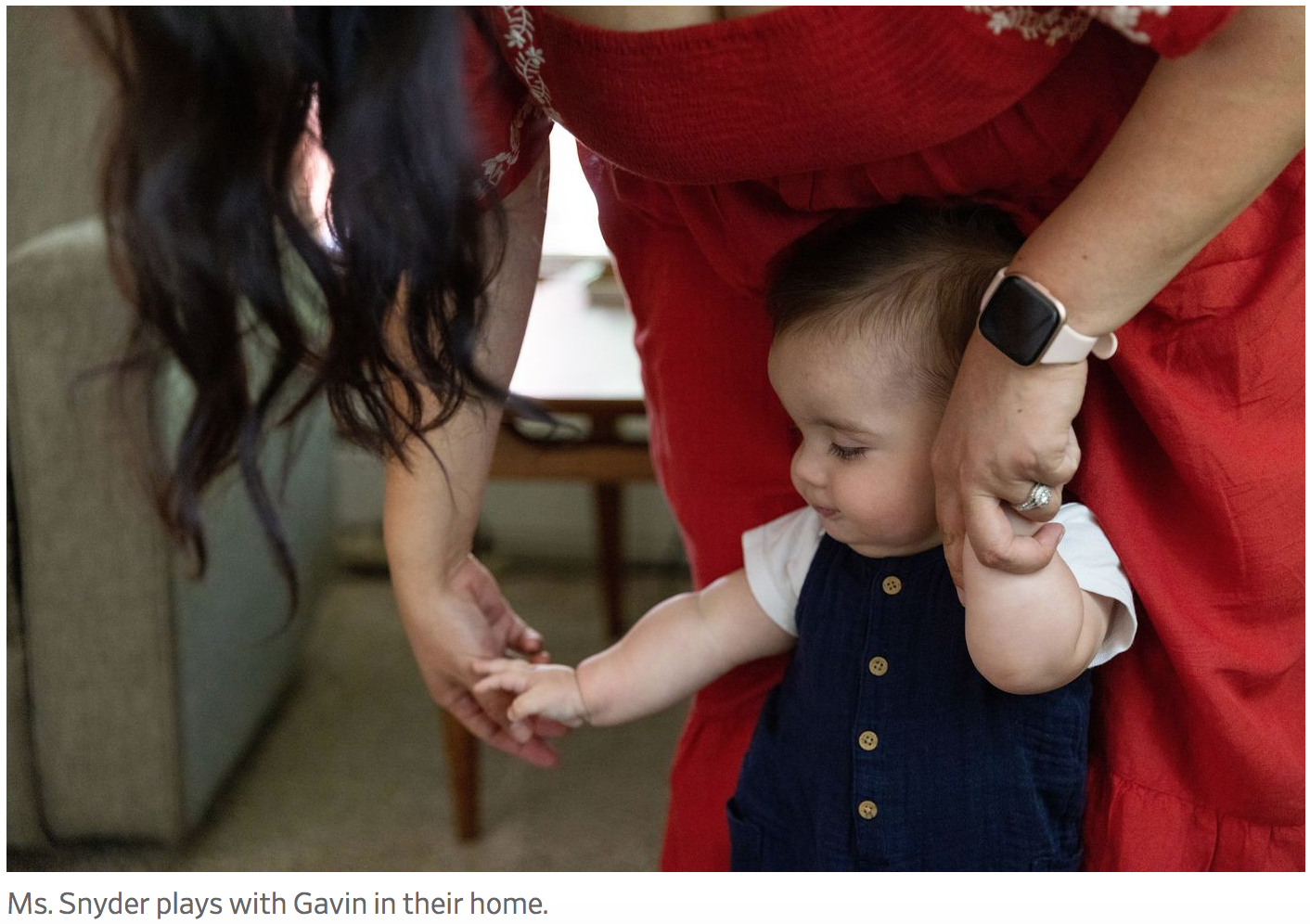
One of the contributing factors in the U.S. baby-formula shortage is a significant shift in the way parents feed their babies: Breast-feeding declined during the pandemic, reversing a decadeslong trend, health practitioners say.
Since 2020, the share of breast-fed one-year-olds has plummeted from an estimated 34% to an estimated 14% this year, according to surveys conducted by Demographic Intelligence, a forecasting firm that specializes in births and works with formula manufacturers including Abbott Laboratories and Nestlé SA. Because of the small sample size, the firm’s 2022 estimate has a range of error of plus or minus 6 percentage points.
Government officials and formula manufacturers are working to address a nationwide shortage that in recent months has resulted in empty shelves at some stores. Causes for the shortage include pandemic-related supply-chain snarls, a February recall by Abbott, as well as the closing of one of its factories.
An increase in demand for formula, driven by the decline in breast-feeding, has exacerbated the problem, according to Lyman Stone, director of research for Demographic Intelligence.
After Covid-19 restrictions were introduced in March 2020, many new mothers had shorter hospital stays and were discharged before their milk had come in or their baby had latched successfully to their breast, breast-feeding experts say. Some infants weren’t given skin-to-skin contact with their mothers after birth because of concerns about Covid-19 transmission.
Some lactation consultants were furloughed, redeployed or designated nonessential personnel; others offered only virtual appointments. Parents had less access to in-person assistance from doulas and peer-support groups. They also had less help from family and friends, who stayed away to avoid exposing newborns to the coronavirus.
Parents who want to breast-feed need a strong support network, said Diane Spatz, a professor of perinatal nursing at the University of Pennsylvania and a nurse scientist at Children’s Hospital of Philadelphia. In the first few days after birth—a critical period for establishing a mother’s milk supply—many families need help troubleshooting. And more broadly, if a mother spends time with other breast-feeding parents, she is likely to nurse her child longer.
“It takes a village,” Dr. Spatz said. During the pandemic, she said, “all the in-person, peer-to-peer support went away.”
Nicole Snyder’s son, Gavin, was born prematurely last September in Kansas City, Mo. For two weeks while he was in the neonatal intensive-care unit, she tried to pump breast milk every two hours. Lactation consultants were on hand to help.
But her mother-in-law, who is a nurse, was barred from visiting her in the hospital, along with her mother and other family members. That heightened Ms. Snyder’s feelings of stress and isolation, which she said contributed to her inability to produce more than a few ounces of milk a day. She and her husband now feed Gavin an Enfamil-brand formula.
“If I could have had visitors, I might have had a little more sanity,” said Ms. Snyder, 34, who works as a middle-school art teacher. “I had a lot of things working against me.”
The American Academy of Pediatrics recommends breast-feeding exclusively for the baby’s first six months, then continuing to breast-feed while introducing complementary foods until the child is at 12 months or older.
Some parents can’t breast-feed their children; others choose not to. Infant formula is the only safe alternative to human breast milk for babies under a year old, health officials say.
Breast-feeding rates in the U.S. reached a low point in the 1970s, when many doctors told parents that formula was the best food for babies. Then a movement to promote breast-feeding, and growing research showing the benefits of breast-feeding over formula, led to a decadeslong increase in breast-feeding.
 Typical dairy barn with filthy floor, walls, and ceiling, circa 1900. “This is the kitchen where baby’s breakfast is prepared,”
 complained one doctor. Source: Milk and Its Relation to the Public Health. Washington, DC: Government Printing Office; 1908.
The share of one-year-olds who are fed with at least some breast milk climbed from 16% in 2001 to 36% in 2017, then plateaued in 2018 and 2019, according to latest data from the Centers for Disease Control and Prevention.
The recent drop in breast-feeding has been particularly steep among lower-income families and people of color, Dr. Spatz said.
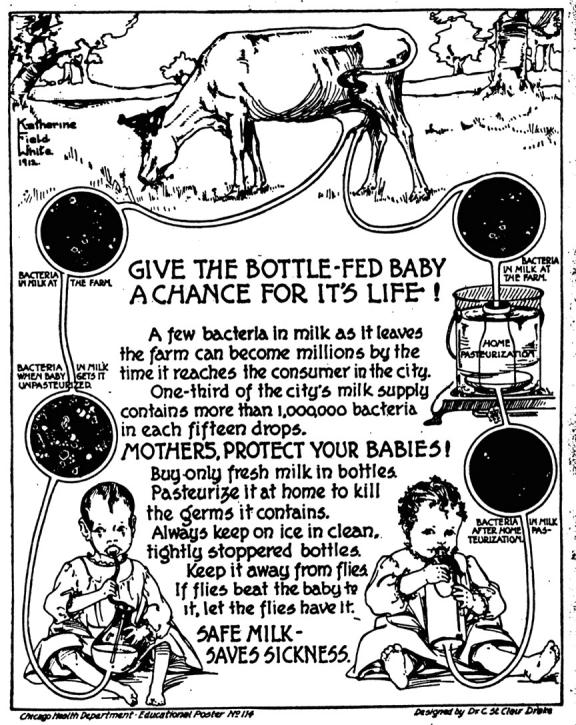
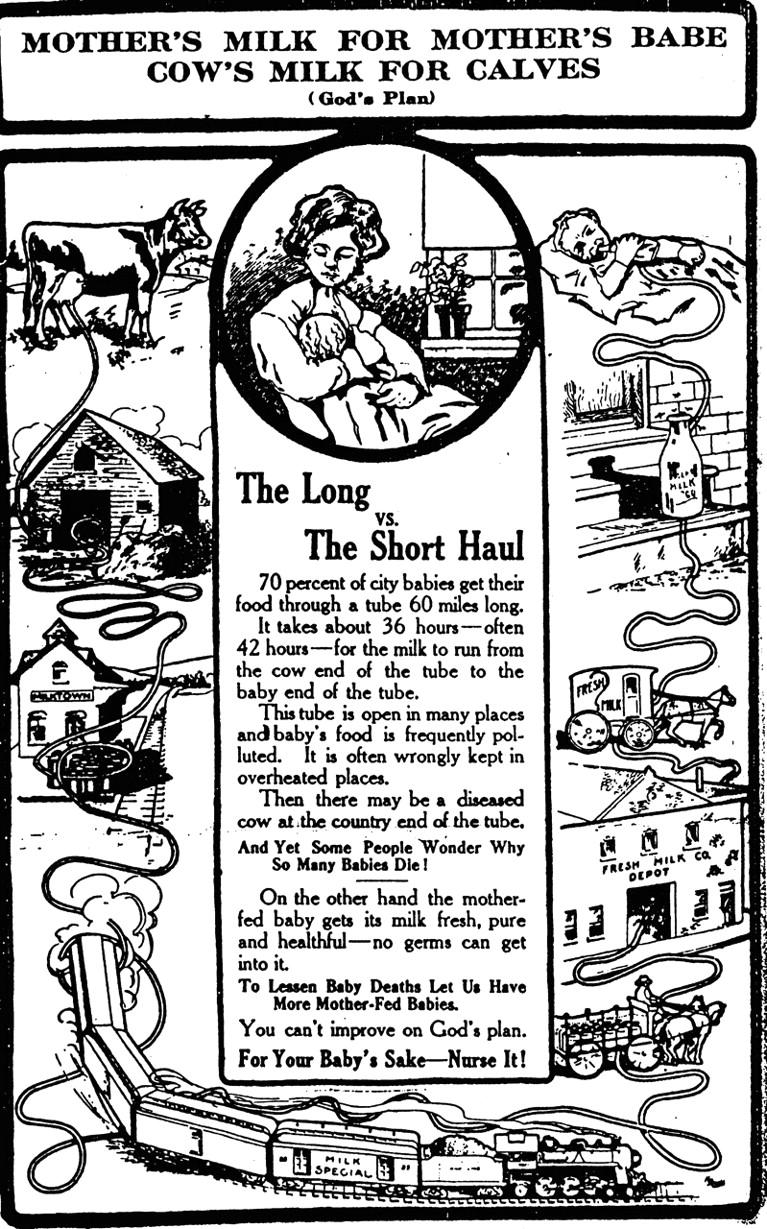
At Children’s Hospital of Philadelphia’s largest pediatric primary-care center, which serves those populations, the percentage of breast-fed babies fell sharply in 2020, Dr. Spatz said. Since then, the share of breast-fed babies at the center has risen but hasn’t returned to prepandemic levels, she said.
The pandemic wasn’t a barrier to breast-feeding for all families. For some, it offered advantages, allowing mothers to nurse for longer because they were working from home, said Kim Hekimian, an assistant professor of nutrition at Columbia University Irving Medical Center.
Other families found workarounds to pandemic restrictions, talking with experienced relatives on video calls, scheduling virtual appointments with lactation consultants and calling support-group help lines.
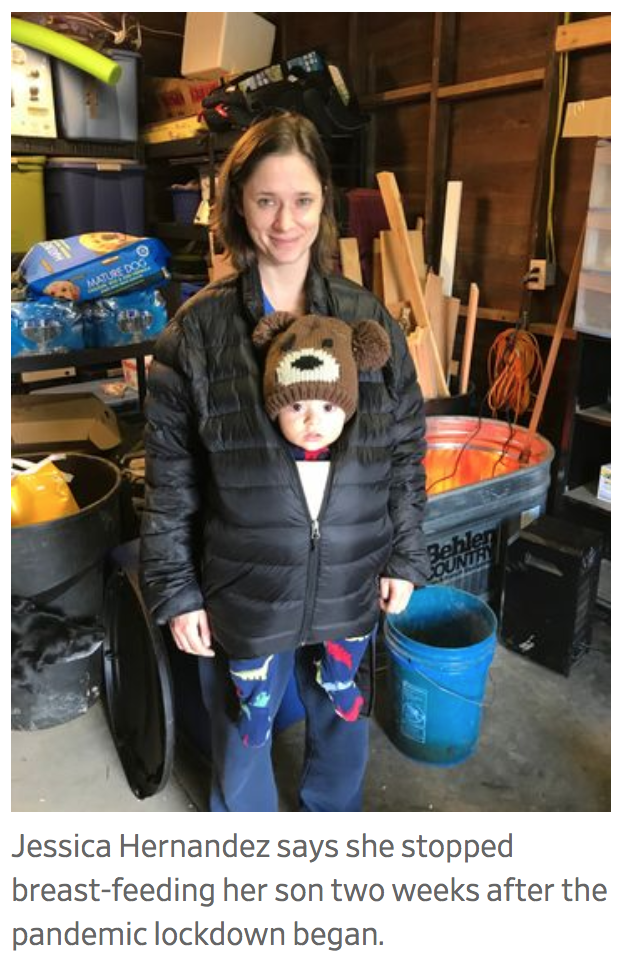
And the expansion of insurance coverage for telehealth visits might have made lactation consultants accessible to more families than before the pandemic, Dr. Hekimian said.
Still, the pandemic placed heavy burdens on parents.
Jessica Hernandez, who lives in rural Washington state, stopped breast-feeding two weeks after the pandemic lockdown began in March 2020. She didn’t have the time to sit still for 40-minute stretches nursing her then-five-month-old baby Teo while trying to home-school a four-year-old and a seven-year-old.
“There was no way that I could keep up with everybody,” Ms. Hernandez said. Once she switched to formula, she said, she could hand Teo to her oldest daughter and say, “OK, feed your brother.”
References:
Related Articles:
Bitcoin Information & Resources (#GotBitcoin)
Houston Software Executive Charged With Largest Tax Evasion Case In History Against An Individual
The Best Solo Miners. Feat. The NerdQaxe++
Bitcoin Bulls Take Over The Military
The Three High-Tech Steps That Can Lower Your Energy Bills
Sauerkraut, Kimchi And…Gut Nuts? Fermented Foods Are Having A Moment
America’s Car Repossessions Business Is Booming If You Have What It Takes!!
These AI Power Users Are Impressing Bosses And Leaving Co-Workers In The Dust
11 Most Famous Black Female Artists
Monty: Is Job-Hoarding Officially Over? AI: Yes
Why Every Family Needs A Code Word
Do You Have What It Takes To Be A $100k A Year Executive Housekeeper?
Ultimate And Complete Guide On Herbs For Culinary And Medicinal Uses
North Korea Is Open. Who’s Going? Apparently Everyone!
Bill Wilson, LSD And The Secret Psychedelic History Of Alcoholics Anonymous
Why America Will Lose The Mercantilist Game
The “Debasement Trade” Is Forcing Investors To Buy Bitcoin And Gold!!
ICE Tracking Apps Are Booming And Digital Resistance Teams Are Ready To Help
From Coders To CEOs: Who’s Earning In/And Accepting (Coffee Shops To Airlines) Bitcoin In 2025
Google Reveals AI Agent Payments Protocol Backed By Bitcoin And TradFi Industry Payment Providers
Vietnam Banks Close 86 Million And Thailand Banks Close 3 Million Customer Accounts
Americans Are Having Less Sex Than Ever
Mushroom Magic In The Kitchen (Recipes)
The Price Of Parenting. TL;DR, It Takes A Helluva Lot of Money
Ultimate Resource On Mushrooms From Foraging, Medicinal, Cultivation And More
Humans Can Echolocate Like Bats And Dolphins. We Explain How It Works
Our Arctic Vacation Itineraries (2026)
Goodbye Gentle Parenting, Hello ‘F—Around And Find Out’
The Many Health Benefits of Nitric Oxide
How To Eliminate Mouth Breathing In Children And Teenagers
We RFK’d The Fries And Food Dyes
Declining Dollar Hits Amazon Forcing It To Raise Prices
Red Yeast Rice VS Prescription Statin Drugs
European Commission Plans A “Reverse Robinhood” Via Savings And Investments Union (SIU)
Un Día Sin Mexicanos (“A Day Without A Mexican”) Is Today!
Is Perplexity AI A Bloomberg Terminal Killer? Not Even Close!
Compounding Pharmacies Explained: Safety, Regulations And More
Sell Stock In Yourself Or Some Of Your Home Equity For Bitcoin
North Korea Infiltrates U.S. Remote Jobs—With The Help of Everyday Americans
America’s Leading Alien Hunters Depend On AI To Speed Their Search
Bitcoin’s Nouveau Riche Executives And Wealthy Investors In Search Of Ways To Protect Themselves
How Anthocyanins Shield Us From Microplastics
Origins Of Toxic Algae (Domoic Acid) Killing Sea Lions, Birds And Dolphins In Southern California
The Human Brain And It’s Ability To Time-Travel
Wall Street’s New Tariff Safe Haven: Biotech Companies Adopting Bitcoin Treasury Strategy
How Natural “Short Sleepers” Thrive On 4 Hours Of Sleep Per Night Thanks To A Gene Mutation
Nine Unknown Benefits of Sleep Including Penal And Clitoral Erections
Elite Athletes Try A New Training Tactic: More Vitamin D3
Bitcoin Industry On A Winning Streak As Sec. Drops Lawsuit After Lawsuit!!
FOIA Files: Elon Musk’s DOGE Wants A Heads Up On FOIA Requests
When Russia Came To Defend The United States
Ultimate Resource Covering DOGE AKA The Department of Government Efficiency
Your Money Is Currently Lawful. However, That Is Subject To Change #GotBitcoin #BitcoinFixesThis
Is The United Nations Going Bankrupt?
Bitcoin Industry Founders Should Stop Chasing Narratives And Start Creating Them
Consumer Finance Watchdog Finalizes ‘Open Banking’ Rules Aimed At Driving Competition
US Government Crypto Wallets Hacked For $20M — Arkham Intelligence
Coinbase Files FOIAs Against US Regulators Probing Banks’ Bitcoin Crackdown
The Botanist Daring To Ask: What If Plants Have Intelligence?
Theoretical Physicist Sylvester James Gates
FOIA Request Reveals SEC’s Gensler, Lawmakers Target Of Violent Threats
Ultimate Resource For Prediction Markets Covering Politics, Pop Culture, Sports And More
September (AKA Rektember) Is Once Again A Tough Month For Stocks AND Bitcoin
Ultimate Resource For Cloning humans. Biological, Ethical, And Social Considerations
FOIA Reveals Aurora Borealis Imperiled US Infrastructure From Power Grids To Satellites (5-10-2024)
Ultimate Resource Covering How “Silent Payments” Are Bringing New Privacy Protections To Bitcoin
Nostr Allows Bitcoiners To Build-Out A Decentralized, CENSORSHIP-RESISTANT Social-Media!!
Joe Rogan: I Have A Lot Of Hope For Bitcoin
Teen Cyber Prodigy Stumbled Onto Flaw Letting Him Hijack Teslas
Spyware Finally Got Scary Enough To Freak Lawmakers Out—After It Spied On Them
The First Nuclear-Powered Bitcoin Mine Is Here. Maybe It Can Clean Up Energy FUD
The World’s Best Bitcoin Policies: How They Do It In 37 Nations
Tonga To Copy El Salvador’s Bill Making Bitcoin Legal Tender, Says Former MP
Wordle Is The New “Lingo” Turning Fans Into Argumentative Strategy Nerds
Prospering In The Pandemic, Some Feel Financial Guilt And Gratitude
Is Art Therapy The Path To Mental Well-Being?
New York, California, New Jersey, And Alabama Move To Ban ‘Forever Chemicals’ In Firefighting Foam
The Mystery Of The Wasting House-Cats
What Pet Owners Should Know About Chronic Kidney Disease In Dogs And Cats
Pets Score Company Perks As The ‘New Dependents’
Why Is My Cat Rubbing His Face In Ants?
Natural Cure For Hyperthyroidism In Cats Including How To Switch Him/Her To A Raw Food Diet
Ultimate Resource For Cat Lovers
FDA Approves First-Ever Arthritis Pain Management Drug For Cats
Ultimate Resource On Duke of York’s Prince Andrew And His Sex Scandal
Walmart Filings Reveal Plans To Create Cryptocurrency, NFTs
Bitcoin’s Dominance of Crypto Payments Is Starting To Erode
T-Mobile Says Hackers Stole Data On About 37 Million Customers
Jack Dorsey Announces Bitcoin Legal Defense Fund
More Than 100 Millionaires Signed An Open Letter Asking To Be Taxed More Heavily
Federal Regulator Says Credit Unions Can Partner With Bitcoin Providers
What’s Behind The Fascination With Smash-And-Grab Shoplifting?
Train Robberies Are A Problem In Los Angeles, And No One Agrees On How To Stop Them
US Stocks Historically Deliver Strong Gains In Fed Hike Cycles (GotBitcoin)
Ian Alexander Jr., Only Child of Regina King, Dies At Age 26
Amazon Ends Its Charity Donation Program Amazonsmile After Other Cost-Cutting Efforts
BTC Panics, Then Jeers at DOJ Announcement of ‘Major Action’ Against Tiny Chinese Exchange Bitzlato
Indexing Is Coming To BTC Funds Via Decentralized Exchanges
Doctors Show Implicit Bias Towards Black Patients
Darkmail Pushes Privacy Into The Hands Of NSA-Weary Customers
3D Printing Make Anything From Candy Bars To Hand Guns
Stealing The Blood Of The Young May Make You More Youthful
Henrietta Lacks And Her Remarkable Cells Will Finally See Some Payback
AL_A Wins Approval For World’s First Magnetized Fusion Power Plant
Want To Be Rich? Bitcoin’s Limited Supply Cap Means You Only Need 0.01 BTC
Smart Money Is Buying Bitcoin Dip. Stocks, Not So Much
McDonald’s Jumps On Bitcoin Memewagon, Crypto Twitter Responds
America COMPETES Act Would Be Disastrous For Bitcoin Inustry (LOL) And More
Lyn Alden On Bitcoin, Inflation And The Potential Coming Energy Shock
Inflation And A Tale of Cantillionaires
El Salvador Plans Bill To Adopt Bitcoin As Legal Tender
Miami Mayor Says City Employees Should Be Able To Take Their Salaries In Bitcoin
Vast Troves of Classified Info Undermine National Security, Spy Chief Says
BREAKING: Arizona State Senator Introduces Bill To Make Bitcoin Legal Tender
San Francisco’s Historic Surveillance Law May Get Watered Down
How Bitcoin Contributions Funded A $1.4M Solar Installation In Zimbabwe
California Lawmaker Says National Privacy Law Is a Priority
The Pandemic Turbocharged Online Privacy Concerns
How To Protect Your Online Privacy While Working From Home
Researchers Use GPU Fingerprinting To Track Users Online
Japan’s $1 Trillion Bitcoin Industry May Ease Onerous Listing Rules
Ultimate Resource On A Weak / Strong Dollar’s Impact On Bitcoin
Fed Money Printer Goes Into Reverse (Quantitative Tightening): What Does It Mean For Crypto?
BTC Market Is Closer To A Bottom Than Stocks (#GotBitcoin)
When World’s Central Banks Get It Wrong, Guess Who Pays The Price??? (#GotBitcoin)
“Better Days Ahead With Crypto Deleveraging Coming To An End” — Joker
Bitcoin Funds Have Seen Record Investment Inflow In Recent Weeks
Bitcoin’s Epic Run Is Winning More Attention On Wall Street
Ultimate Resource For Bitcoin Industry Mergers And Acquisitions (M&A) (#GotBitcoin)
Why Wall Street Is Literally Salivating Over Bitcoin
Nasdaq-Listed MicroStrategy And Others Wary Of Looming Dollar Inflation, Turns To Bitcoin And Gold
Bitcoin For Corporations | Michael Saylor | Bitcoin Corporate Strategy
Ultimate Resource On Myanmar’s Involvement With Bitcoin Industry
‘I Cry Every Day’: Olympic Athletes Slam Food, COVID Tests And Conditions In Beijing
Does Your Baby’s Food Contain Toxic Metals? Here’s What Our Investigation Found
Ultimate Resource For Pro-Bitcoin Lobbying And Non-Profit Organizations
Ultimate Resource On BlockFi, Celsius And Nexo
Petition Calling For Resignation Of U.S. Securities/Exchange Commission Chair Gary Gensler
100 Million Americans Can Legally Bet on the Super Bowl. A Spot Bitcoin ETF? Forget About it!
Green Finance Isn’t Going Where It’s Needed
Shedding Some Light On The Murky World Of ESG Metrics
SEC Targets Greenwashers To Bring Law And Order To ESG
BlackRock (Assets Under Management $7.4 Trillion) CEO: Bitcoin Has Caught Our Attention
Canada’s Major Banks Go Offline In Mysterious (Bank Run?) Hours-Long Outage (#GotBitcoin)
On-Chain Data: A Framework To Evaluate Bitcoin
On Its 14th Birthday, Bitcoin’s 1,690,706,971% Gain Looks Kind of… Well Insane
The Most Important Health Metric Is Now At Your Fingertips
American Bargain Hunters Flock To A New Online Platform Forged In China
Why We Should Welcome Another Crypto Winter
Traders Prefer Gold, Fiat Safe Havens Over Bitcoin As Russia Goes To War
Music Distributor DistroKid Raises Money At $1.3 Billion Valuation
Nas Selling Rights To Two Songs Via Crypto Music Startup Royal
Ultimate Resource On Music Catalog Deals
Ultimate Resource On Music And NFTs And The Implications For The Entertainment Industry
Lead And Cadmium Could Be In Your Dark Chocolate
Catawba, Native-American Tribe Approves First Digital Economic Zone In The United States
The Miracle Of Blockchain’s Triple Entry Accounting
How And Why To Stimulate Your Vagus Nerve!
Housing Boom Brings A Shortage Of Land To Build New Homes
Biden Lays Out His Blueprint For Fair Housing
No Grave Dancing For Sam Zell Now. He’s Paying Up For Hot Properties
Cracks In The Housing Market Are Starting To Show
Ever-Growing Needs Strain U.S. Food Bank Operations
Food Pantry Helps Columbia Students Struggling To Pay Bills
Food Insecurity Driven By Climate Change Has Central Americans Fleeing To The U.S.
Housing Insecurity Is Now A Concern In Addition To Food Insecurity
Families Face Massive Food Insecurity Levels
US Troops Going Hungry (Food Insecurity) Is A National Disgrace
Everything You Should Know About Community Fridges, From Volunteering To Starting Your Own
Russia’s Independent Journalists Including Those Who Revealed The Pandora Papers Need Your Help
10 Women Who Used Crypto To Make A Difference In 2021
Happy International Women’s Day! Leaders Share Their Experiences In Crypto
Dollar On Course For Worst Performance In Over A Decade (#GotBitcoin)
Juice The Stock Market And Destroy The Dollar!! (#GotBitcoin)
Unusual Side Hustles You May Not Have Thought Of
Ultimate Resource On Global Inflation And Rising Interest Rates (#GotBitcoin)
The Fed Is Setting The Stage For Hyper-Inflation Of The Dollar (#GotBitcoin)
An Antidote To Inflation? ‘Buy Nothing’ Groups Gain Popularity
Why Is Bitcoin Dropping If It’s An ‘Inflation Hedge’?
Lyn Alden Talks Bitcoin, Inflation And The Potential Coming Energy Shock
Ultimate Resource On How Black Families Can Fight Against Rising Inflation (#GotBitcoin)
What The Fed’s Rate Hike Means For Inflation, Housing, Crypto And Stocks
Egyptians Buy Bitcoin Despite Prohibitive New Banking Laws
Archaeologists Uncover Five Tombs In Egypt’s Saqqara Necropolis
History of Alchemy From Ancient Egypt To Modern Times
Former World Bank Chief Didn’t Act On Warnings Of Sexual Harassment
Does Your Hospital or Doctor Have A Financial Relationship With Big Pharma?
Ultimate Resource Covering The Crisis Taking Place In The Nickel Market
Apple Along With Meta And Secret Service Agents Fooled By Law Enforcement Impersonators
Handy Tech That Can Support Your Fitness Goals
How To Naturally Increase Your White Blood Cell Count
Ultimate Source For Russians Oligarchs And The Impact Of Sanctions On Them
Ultimate Source For Bitcoin Price Manipulation By Wall Street
Russia, Sri Lanka And Lebanon’s Defaults Could Be The First Of Many (#GotBitcoin)
Will Community Group Buying Work In The US?
Building And Running Businesses In The ‘Spirit Of Bitcoin’
What Is The Mysterious Liver Disease Hurting (And Killing) Children?
Citigroup Trader Is Scapegoat For Flash Crash In European Stocks (#GotBitcoin)
Bird Flu Outbreak Approaches Worst Ever In U.S. With 37 Million Animals Dead
Financial Inequality Grouped By Race For Blacks, Whites And Hispanics
How Black Businesses Can Prosper From Targeting A Trillion-Dollar Black Culture Market (#GotBitcoin)
Ultimate Resource For Central Bank Digital Currencies (#GotBitcoin) Page#2
Meet The Crypto Angel Investor Running For Congress In Nevada (#GotBitcoin?)
Introducing BTCPay Vault – Use Any Hardware Wallet With BTCPay And Its Full Node (#GotBitcoin?)
How Not To Lose Your Coins In 2020: Alternative Recovery Methods (#GotBitcoin?)
H.R.5635 – Virtual Currency Tax Fairness Act of 2020 ($200.00 Limit) 116th Congress (2019-2020)
Adam Back On Satoshi Emails, Privacy Concerns And Bitcoin’s Early Days
The Prospect of Using Bitcoin To Build A New International Monetary System Is Getting Real
How To Raise Funds For Australia Wildfire Relief Efforts (Using Bitcoin And/Or Fiat )
Former Regulator Known As ‘Crypto Dad’ To Launch Digital-Dollar Think Tank (#GotBitcoin?)
Currency ‘Cold War’ Takes Center Stage At Pre-Davos Crypto Confab (#GotBitcoin?)
A Blockchain-Secured Home Security Camera Won Innovation Awards At CES 2020 Las Vegas
Bitcoin’s Had A Sensational 11 Years (#GotBitcoin?)
Sergey Nazarov And The Creation Of A Decentralized Network Of Oracles
Google Suspends MetaMask From Its Play App Store, Citing “Deceptive Services”
Christmas Shopping: Where To Buy With Crypto This Festive Season
At 8,990,000% Gains, Bitcoin Dwarfs All Other Investments This Decade
Coinbase CEO Armstrong Wins Patent For Tech Allowing Users To Email Bitcoin
Bitcoin Has Got Society To Think About The Nature Of Money
How DeFi Goes Mainstream In 2020: Focus On Usability (#GotBitcoin?)
Dissidents And Activists Have A Lot To Gain From Bitcoin, If Only They Knew It (#GotBitcoin?)
At A Refugee Camp In Iraq, A 16-Year-Old Syrian Is Teaching Crypto Basics
Bitclub Scheme Busted In The US, Promising High Returns From Mining
Bitcoin Advertised On French National TV
Germany: New Proposed Law Would Legalize Banks Holding Bitcoin
How To Earn And Spend Bitcoin On Black Friday 2019
The Ultimate List of Bitcoin Developments And Accomplishments
Charities Put A Bitcoin Twist On Giving Tuesday
Family Offices Finally Accept The Benefits of Investing In Bitcoin
An Army Of Bitcoin Devs Is Battle-Testing Upgrades To Privacy And Scaling
Bitcoin ‘Carry Trade’ Can Net Annual Gains With Little Risk, Says PlanB
Max Keiser: Bitcoin’s ‘Self-Settlement’ Is A Revolution Against Dollar
Blockchain Can And Will Replace The IRS
China Seizes The Blockchain Opportunity. How Should The US Respond? (#GotBitcoin?)
Jack Dorsey: You Can Buy A Fraction Of Berkshire Stock Or ‘Stack Sats’
Bitcoin Price Skyrockets $500 In Minutes As Bakkt BTC Contracts Hit Highs
Bitcoin’s Irreversibility Challenges International Private Law: Legal Scholar
Bitcoin Has Already Reached 40% Of Average Fiat Currency Lifespan
Yes, Even Bitcoin HODLers Can Lose Money In The Long-Term: Here’s How (#GotBitcoin?)
Unicef To Accept Donations In Bitcoin (#GotBitcoin?)
Former Prosecutor Asked To “Shut Down Bitcoin” And Is Now Face Of Crypto VC Investing (#GotBitcoin?)
Switzerland’s ‘Crypto Valley’ Is Bringing Blockchain To Zurich
Next Bitcoin Halving May Not Lead To Bull Market, Says Bitmain CEO
Bitcoin Developer Amir Taaki, “We Can Crash National Economies” (#GotBitcoin?)
Veteran Crypto And Stocks Trader Shares 6 Ways To Invest And Get Rich
Is Chainlink Blazing A Trail Independent Of Bitcoin?
Nearly $10 Billion In BTC Is Held In Wallets Of 8 Crypto Exchanges (#GotBitcoin?)
SEC Enters Settlement Talks With Alleged Fraudulent Firm Veritaseum (#GotBitcoin?)
Blockstream’s Samson Mow: Bitcoin’s Block Size Already ‘Too Big’
Attorneys Seek Bank Of Ireland Execs’ Testimony Against OneCoin Scammer (#GotBitcoin?)
OpenLibra Plans To Launch Permissionless Fork Of Facebook’s Stablecoin (#GotBitcoin?)
Tiny $217 Options Trade On Bitcoin Blockchain Could Be Wall Street’s Death Knell (#GotBitcoin?)
Class Action Accuses Tether And Bitfinex Of Market Manipulation (#GotBitcoin?)
Sharia Goldbugs: How ISIS Created A Currency For World Domination (#GotBitcoin?)
Bitcoin Eyes Demand As Hong Kong Protestors Announce Bank Run (#GotBitcoin?)
How To Securely Transfer Crypto To Your Heirs
‘Gold-Backed’ Crypto Token Promoter Karatbars Investigated By Florida Regulators (#GotBitcoin?)
Crypto News From The Spanish-Speaking World (#GotBitcoin?)
Financial Services Giant Morningstar To Offer Ratings For Crypto Assets (#GotBitcoin?)
‘Gold-Backed’ Crypto Token Promoter Karatbars Investigated By Florida Regulators (#GotBitcoin?)
The Original Sins Of Cryptocurrencies (#GotBitcoin?)
Bitcoin Is The Fraud? JPMorgan Metals Desk Fixed Gold Prices For Years (#GotBitcoin?)
Israeli Startup That Allows Offline Crypto Transactions Secures $4M (#GotBitcoin?)
[PSA] Non-genuine Trezor One Devices Spotted (#GotBitcoin?)
Bitcoin Stronger Than Ever But No One Seems To Care: Google Trends (#GotBitcoin?)
First-Ever SEC-Qualified Token Offering In US Raises $23 Million (#GotBitcoin?)
You Can Now Prove A Whole Blockchain With One Math Problem – Really
Crypto Mining Supply Fails To Meet Market Demand In Q2: TokenInsight
$2 Billion Lost In Mt. Gox Bitcoin Hack Can Be Recovered, Lawyer Claims (#GotBitcoin?)
Fed Chair Says Agency Monitoring Crypto But Not Developing Its Own (#GotBitcoin?)
Wesley Snipes Is Launching A Tokenized $25 Million Movie Fund (#GotBitcoin?)
Mystery 94K BTC Transaction Becomes Richest Non-Exchange Address (#GotBitcoin?)
A Crypto Fix For A Broken International Monetary System (#GotBitcoin?)
Four Out Of Five Top Bitcoin QR Code Generators Are Scams: Report (#GotBitcoin?)
Waves Platform And The Abyss To Jointly Launch Blockchain-Based Games Marketplace (#GotBitcoin?)
Bitmain Ramps Up Power And Efficiency With New Bitcoin Mining Machine (#GotBitcoin?)
Ledger Live Now Supports Over 1,250 Ethereum-Based ERC-20 Tokens (#GotBitcoin?)
Miss Finland: Bitcoin’s Risk Keeps Most Women Away From Cryptocurrency (#GotBitcoin?)
Artist Akon Loves BTC And Says, “It’s Controlled By The People” (#GotBitcoin?)
Ledger Live Now Supports Over 1,250 Ethereum-Based ERC-20 Tokens (#GotBitcoin?)
Co-Founder Of LinkedIn Presents Crypto Rap Video: Hamilton Vs. Satoshi (#GotBitcoin?)
Crypto Insurance Market To Grow, Lloyd’s Of London And Aon To Lead (#GotBitcoin?)
No ‘AltSeason’ Until Bitcoin Breaks $20K, Says Hedge Fund Manager (#GotBitcoin?)
NSA Working To Develop Quantum-Resistant Cryptocurrency: Report (#GotBitcoin?)
Custody Provider Legacy Trust Launches Crypto Pension Plan (#GotBitcoin?)
Vaneck, SolidX To Offer Limited Bitcoin ETF For Institutions Via Exemption (#GotBitcoin?)
Russell Okung: From NFL Superstar To Bitcoin Educator In 2 Years (#GotBitcoin?)
Bitcoin Miners Made $14 Billion To Date Securing The Network (#GotBitcoin?)
Why Does Amazon Want To Hire Blockchain Experts For Its Ads Division?
Argentina’s Economy Is In A Technical Default (#GotBitcoin?)
Blockchain-Based Fractional Ownership Used To Sell High-End Art (#GotBitcoin?)
Portugal Tax Authority: Bitcoin Trading And Payments Are Tax-Free (#GotBitcoin?)
Bitcoin ‘Failed Safe Haven Test’ After 7% Drop, Peter Schiff Gloats (#GotBitcoin?)
Bitcoin Dev Reveals Multisig UI Teaser For Hardware Wallets, Full Nodes (#GotBitcoin?)
Bitcoin Price: $10K Holds For Now As 50% Of CME Futures Set To Expire (#GotBitcoin?)
Bitcoin Realized Market Cap Hits $100 Billion For The First Time (#GotBitcoin?)
Stablecoins Begin To Look Beyond The Dollar (#GotBitcoin?)
Bank Of England Governor: Libra-Like Currency Could Replace US Dollar (#GotBitcoin?)
Binance Reveals ‘Venus’ — Its Own Project To Rival Facebook’s Libra (#GotBitcoin?)
The Real Benefits Of Blockchain Are Here. They’re Being Ignored (#GotBitcoin?)
CommBank Develops Blockchain Market To Boost Biodiversity (#GotBitcoin?)
SEC Approves Blockchain Tech Startup Securitize To Record Stock Transfers (#GotBitcoin?)
SegWit Creator Introduces New Language For Bitcoin Smart Contracts (#GotBitcoin?)
You Can Now Earn Bitcoin Rewards For Postmates Purchases (#GotBitcoin?)
Bitcoin Price ‘Will Struggle’ In Big Financial Crisis, Says Investor (#GotBitcoin?)
Fidelity Charitable Received Over $100M In Crypto Donations Since 2015 (#GotBitcoin?)
Would Blockchain Better Protect User Data Than FaceApp? Experts Answer (#GotBitcoin?)
Just The Existence Of Bitcoin Impacts Monetary Policy (#GotBitcoin?)
What Are The Biggest Alleged Crypto Heists And How Much Was Stolen? (#GotBitcoin?)
IRS To Cryptocurrency Owners: Come Clean, Or Else!
Coinbase Accidentally Saves Unencrypted Passwords Of 3,420 Customers (#GotBitcoin?)
Bitcoin Is A ‘Chaos Hedge, Or Schmuck Insurance‘ (#GotBitcoin?)
Bakkt Announces September 23 Launch Of Futures And Custody
Coinbase CEO: Institutions Depositing $200-400M Into Crypto Per Week (#GotBitcoin?)
Researchers Find Monero Mining Malware That Hides From Task Manager (#GotBitcoin?)
Crypto Dusting Attack Affects Nearly 300,000 Addresses (#GotBitcoin?)
A Case For Bitcoin As Recession Hedge In A Diversified Investment Portfolio (#GotBitcoin?)
SEC Guidance Gives Ammo To Lawsuit Claiming XRP Is Unregistered Security (#GotBitcoin?)
15 Countries To Develop Crypto Transaction Tracking System: Report (#GotBitcoin?)
US Department Of Commerce Offering 6-Figure Salary To Crypto Expert (#GotBitcoin?)
Mastercard Is Building A Team To Develop Crypto, Wallet Projects (#GotBitcoin?)
Canadian Bitcoin Educator Scams The Scammer And Donates Proceeds (#GotBitcoin?)
Amazon Wants To Build A Blockchain For Ads, New Job Listing Shows (#GotBitcoin?)
Shield Bitcoin Wallets From Theft Via Time Delay (#GotBitcoin?)
Blockstream Launches Bitcoin Mining Farm With Fidelity As Early Customer (#GotBitcoin?)
Commerzbank Tests Blockchain Machine To Machine Payments With Daimler (#GotBitcoin?)
Man Takes Bitcoin Miner Seller To Tribunal Over Electricity Bill And Wins (#GotBitcoin?)
Bitcoin’s Computing Power Sets Record As Over 100K New Miners Go Online (#GotBitcoin?)
Walmart Coin And Libra Perform Major Public Relations For Bitcoin (#GotBitcoin?)
Judge Says Buying Bitcoin Via Credit Card Not Necessarily A Cash Advance (#GotBitcoin?)
Poll: If You’re A Stockowner Or Crypto-Currency Holder. What Will You Do When The Recession Comes?
1 In 5 Crypto Holders Are Women, New Report Reveals (#GotBitcoin?)
Beating Bakkt, Ledgerx Is First To Launch ‘Physical’ Bitcoin Futures In Us (#GotBitcoin?)
Facebook Warns Investors That Libra Stablecoin May Never Launch (#GotBitcoin?)
Government Money Printing Is ‘Rocket Fuel’ For Bitcoin (#GotBitcoin?)
Bitcoin-Friendly Square Cash App Stock Price Up 56% In 2019 (#GotBitcoin?)
Safeway Shoppers Can Now Get Bitcoin Back As Change At 894 US Stores (#GotBitcoin?)
TD Ameritrade CEO: There’s ‘Heightened Interest Again’ With Bitcoin (#GotBitcoin?)
Venezuela Sets New Bitcoin Volume Record Thanks To 10,000,000% Inflation (#GotBitcoin?)
Newegg Adds Bitcoin Payment Option To 73 More Countries (#GotBitcoin?)
China’s Schizophrenic Relationship With Bitcoin (#GotBitcoin?)
More Companies Build Products Around Crypto Hardware Wallets (#GotBitcoin?)
Bakkt Is Scheduled To Start Testing Its Bitcoin Futures Contracts Today (#GotBitcoin?)
Bitcoin Network Now 8 Times More Powerful Than It Was At $20K Price (#GotBitcoin?)
Crypto Exchange BitMEX Under Investigation By CFTC: Bloomberg (#GotBitcoin?)
“Bitcoin An ‘Unstoppable Force,” Says US Congressman At Crypto Hearing (#GotBitcoin?)
Bitcoin Network Is Moving $3 Billion Daily, Up 210% Since April (#GotBitcoin?)
Cryptocurrency Startups Get Partial Green Light From Washington
Fundstrat’s Tom Lee: Bitcoin Pullback Is Healthy, Fewer Searches Аre Good (#GotBitcoin?)
Bitcoin Lightning Nodes Are Snatching Funds From Bad Actors (#GotBitcoin?)
The Provident Bank Now Offers Deposit Services For Crypto-Related Entities (#GotBitcoin?)
Bitcoin Could Help Stop News Censorship From Space (#GotBitcoin?)
US Sanctions On Iran Crypto Mining — Inevitable Or Impossible? (#GotBitcoin?)
US Lawmaker Reintroduces ‘Safe Harbor’ Crypto Tax Bill In Congress (#GotBitcoin?)
EU Central Bank Won’t Add Bitcoin To Reserves — Says It’s Not A Currency (#GotBitcoin?)
The Miami Dolphins Now Accept Bitcoin And Litecoin Crypt-Currency Payments (#GotBitcoin?)
Trump Bashes Bitcoin And Alt-Right Is Mad As Hell (#GotBitcoin?)
Goldman Sachs Ramps Up Development Of New Secret Crypto Project (#GotBitcoin?)
Blockchain And AI Bond, Explained (#GotBitcoin?)
Grayscale Bitcoin Trust Outperformed Indexes In First Half Of 2019 (#GotBitcoin?)
XRP Is The Worst Performing Major Crypto Of 2019 (GotBitcoin?)
Bitcoin Back Near $12K As BTC Shorters Lose $44 Million In One Morning (#GotBitcoin?)
As Deutsche Bank Axes 18K Jobs, Bitcoin Offers A ‘Plan ฿”: VanEck Exec (#GotBitcoin?)
Argentina Drives Global LocalBitcoins Volume To Highest Since November (#GotBitcoin?)
‘I Would Buy’ Bitcoin If Growth Continues — Investment Legend Mobius (#GotBitcoin?)
Lawmakers Push For New Bitcoin Rules (#GotBitcoin?)
Facebook’s Libra Is Bad For African Americans (#GotBitcoin?)
Crypto Firm Charity Announces Alliance To Support Feminine Health (#GotBitcoin?)
Canadian Startup Wants To Upgrade Millions Of ATMs To Sell Bitcoin (#GotBitcoin?)
Trump Says US ‘Should Match’ China’s Money Printing Game (#GotBitcoin?)
Casa Launches Lightning Node Mobile App For Bitcoin Newbies (#GotBitcoin?)
Bitcoin Rally Fuels Market In Crypto Derivatives (#GotBitcoin?)
World’s First Zero-Fiat ‘Bitcoin Bond’ Now Available On Bloomberg Terminal (#GotBitcoin?)
Buying Bitcoin Has Been Profitable 98.2% Of The Days Since Creation (#GotBitcoin?)
Another Crypto Exchange Receives License For Crypto Futures
From ‘Ponzi’ To ‘We’re Working On It’ — BIS Chief Reverses Stance On Crypto (#GotBitcoin?)
These Are The Cities Googling ‘Bitcoin’ As Interest Hits 17-Month High (#GotBitcoin?)
Venezuelan Explains How Bitcoin Saves His Family (#GotBitcoin?)
Quantum Computing Vs. Blockchain: Impact On Cryptography
This Fund Is Riding Bitcoin To Top (#GotBitcoin?)
Bitcoin’s Surge Leaves Smaller Digital Currencies In The Dust (#GotBitcoin?)
Bitcoin Exchange Hits $1 Trillion In Trading Volume (#GotBitcoin?)
Bitcoin Breaks $200 Billion Market Cap For The First Time In 17 Months (#GotBitcoin?)
You Can Now Make State Tax Payments In Bitcoin (#GotBitcoin?)
Religious Organizations Make Ideal Places To Mine Bitcoin (#GotBitcoin?)
Goldman Sacs And JP Morgan Chase Finally Concede To Crypto-Currencies (#GotBitcoin?)
Bitcoin Heading For Fifth Month Of Gains Despite Price Correction (#GotBitcoin?)
Breez Reveals Lightning-Powered Bitcoin Payments App For IPhone (#GotBitcoin?)
Big Four Auditing Firm PwC Releases Cryptocurrency Auditing Software (#GotBitcoin?)
Amazon-Owned Twitch Quietly Brings Back Bitcoin Payments (#GotBitcoin?)
JPMorgan Will Pilot ‘JPM Coin’ Stablecoin By End Of 2019: Report (#GotBitcoin?)
Is There A Big Short In Bitcoin? (#GotBitcoin?)
Coinbase Hit With Outage As Bitcoin Price Drops $1.8K In 15 Minutes
Samourai Wallet Releases Privacy-Enhancing CoinJoin Feature (#GotBitcoin?)
There Are Now More Than 5,000 Bitcoin ATMs Around The World (#GotBitcoin?)
You Can Now Get Bitcoin Rewards When Booking At Hotels.Com (#GotBitcoin?)
North America’s Largest Solar Bitcoin Mining Farm Coming To California (#GotBitcoin?)
Bitcoin On Track For Best Second Quarter Price Gain On Record (#GotBitcoin?)
Bitcoin Hash Rate Climbs To New Record High Boosting Network Security (#GotBitcoin?)
Bitcoin Exceeds 1Million Active Addresses While Coinbase Custodies $1.3B In Assets
Why Bitcoin’s Price Suddenly Surged Back $5K (#GotBitcoin?)
Zebpay Becomes First Exchange To Add Lightning Payments For All Users (#GotBitcoin?)
Coinbase’s New Customer Incentive: Interest Payments, With A Crypto Twist (#GotBitcoin?)
The Best Bitcoin Debit (Cashback) Cards Of 2019 (#GotBitcoin?)
Real Estate Brokerages Now Accepting Bitcoin (#GotBitcoin?)
Ernst & Young Introduces Tax Tool For Reporting Cryptocurrencies (#GotBitcoin?)
Recession Is Looming, or Not. Here’s How To Know (#GotBitcoin?)
How Will Bitcoin Behave During A Recession? (#GotBitcoin?)
Many U.S. Financial Officers Think a Recession Will Hit Next Year (#GotBitcoin?)
Definite Signs of An Imminent Recession (#GotBitcoin?)
What A Recession Could Mean for Women’s Unemployment (#GotBitcoin?)
Investors Run Out of Options As Bitcoin, Stocks, Bonds, Oil Cave To Recession Fears (#GotBitcoin?)
Goldman Is Looking To Reduce “Marcus” Lending Goal On Credit (Recession) Caution (#GotBitcoin?)
Leave a Reply
You must be logged in to post a comment.