
Short Sellers Bet On Opioid Fallout Sinking Drug Companies’ Stocks
Hedge funds target drugmakers in expectation of financial pressures from potential settlements. Short Sellers Bet On Opioid Fallout Sinking Drug Companies’ Stocks (#GotBitcoin?)
Related:
Opiate-Addicted Babies Are The New Crack Babies of 2025-26
Freedom of Information Act Document Reveals Antidepressant Drugs Are Less Effective Than Placebos
Fentanyl’s New Foe: A Quick Test Strip That Can Prevent Overdoses
Pharmaceuticals Found In Our Drinking Water!
At an investor lunch in late March, the chief executive of drugmaker Mallinckrodt PLC, one of the largest generic oxycodone producers in the U.S., said he expected the company would bear no liability for its alleged role in the opioid crisis, according to people familiar with the meeting.
Some Investors Are Betting Otherwise
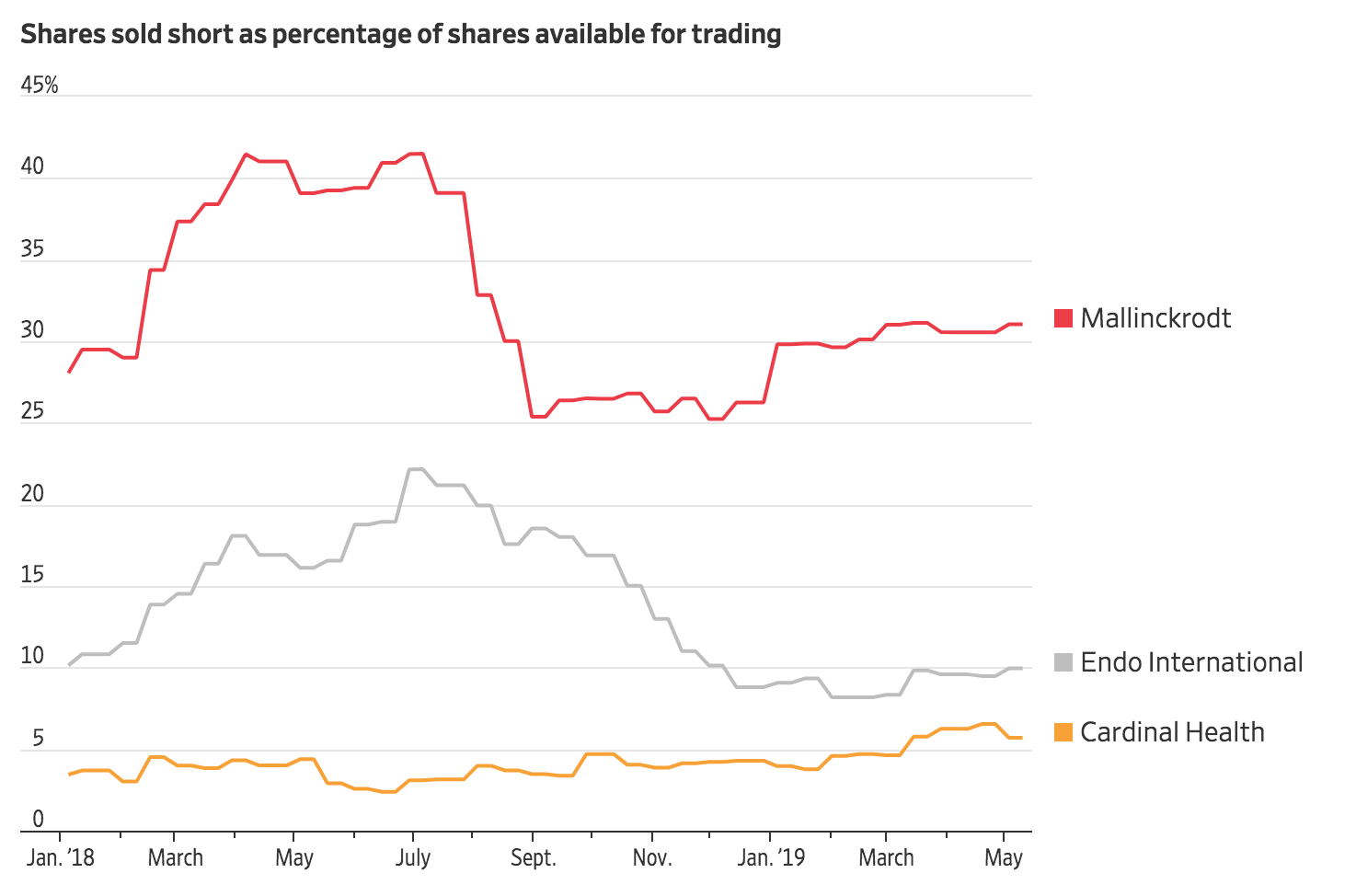
Around 2,000 lawsuits have been brought by municipalities and other plaintiffs accusing companies in the pharmaceutical supply chain, including Mallinckrodt, of fueling the opioid epidemic. “Wall Street is underestimating the impact on companies from the opioid litigation,” said Justin Simon of health-care hedge fund Jasper Capital Management LP in Chevy Chase, Md., who has been betting against Mallinckrodt and some other companies named in the lawsuits.
Drugmakers including Mallinckrodt, Allergan PLC, Endo International Inc., Johnson & Johnson and Teva Pharmaceutical Industries Ltd., along with several drug distributors, have been named as defendants in the lawsuits and are the subject of hedge funds’ wagers that the companies will face costly settlements.
The companies named in the suits have been fighting the litigation and denied liability for the opioid crisis. Nearly 400,000 Americans have died from opioid overdoses from 1999 to 2017, according to the Centers for Disease Control and Prevention, with the rate of deaths picking up over time. A Mallinckrodt spokesman said the company would vigorously defend itself against the claims and that “at this point, there is no settlement that is probable and estimable.” He also said Mallinckrodt expects any such settlement to be manageable.
Short sellers won big this week when shares of Insys Therapeutics Inc. fell 74% on Monday after the company said it might have to file for bankruptcy partly because of costs and liabilities related to opioid lawsuits. In a short sale, investors sell borrowed shares in hopes they can buy them back at a lower price, return the stock and pocket the difference.
Earlier this month, Insys Therapeutics co-founder John Kapoor was among five executives of the company, which sold a fentanyl spray for treating cancer-related pain, who were convicted of engaging in a racketeering conspiracy to boost prescription opioid sales. Insys has said actions taken by “a select few former employees” don’t represent the company’s current work.
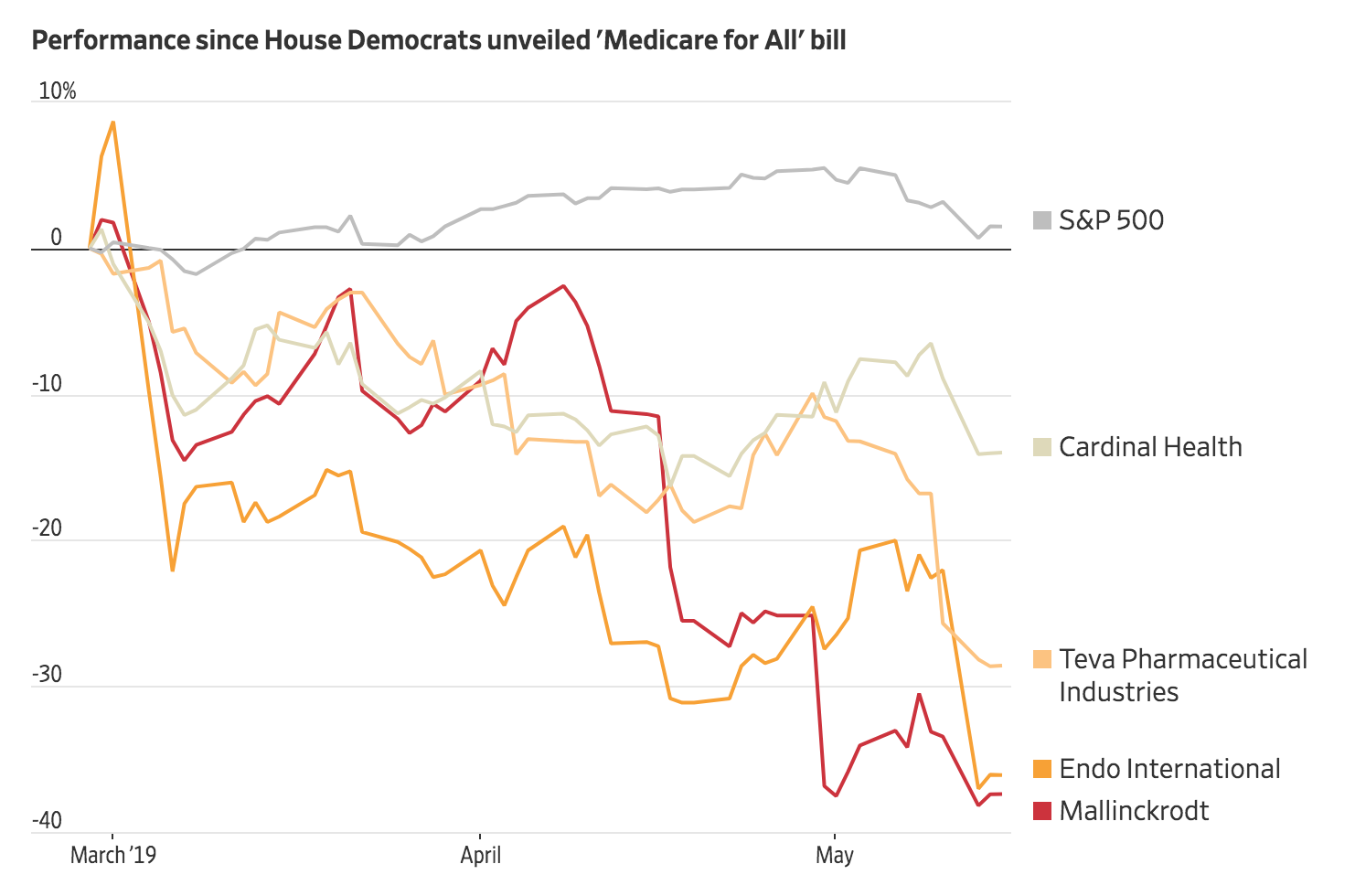
The opioid litigation is just one of many problems facing the health-care industry, which is the worst-performing sector in the S&P 500 this year. Those issues include public resistance to drug-price increases, the possibility of universal health-care legislation, lawsuits alleging that pharmaceutical companies colluded to raise generic drug prices and the Trump administration’s proposed overhaul of drug rebates.
Investors such as James Chanos and BR Dialectic Capital Management LLC have placed bets on or against Mallinckrodt or other companies up and down what traders call the “pain chain,” betting that in addition to other factors affecting the sector, the companies would have to make payments for their alleged roles in the opioid crisis.
Plaintiffs broadly allege manufacturers misrepresented the addictive risks of their drugs and aggressively marketed them to doctors. Distributors, meanwhile, are accused of failing to flag suspicious orders and flooding communities with pills.
It isn’t clear whether the plaintiffs will win their lawsuits or see windfalls.
While the claims related to the crisis have been compared with landmark cases brought against tobacco companies in the 1990s, they are far more complex in both the number of plaintiffs and defendants involved and in the separate tracks—federal and state—involved. Complex-litigation experts said they accordingly expect it to be more difficult for any global settlement to be reached.
Defendants argue opioid deaths can also be blamed on doctors who write inappropriate prescriptions and on illegal opioids like heroin. In court filings, drugmakers and distributors point to the roles of the Food and Drug Administration and the Drug Enforcement Administration in approving opioids and overseeing their distribution.
Some investors see the risks as manageable. The Baupost Group, run by well-known value investor Seth Klarman, has been invested in distributors that have been named in opioid-related suits, including AmerisourceBergen Corp. , Cardinal Health Inc. and McKesson Corp. Baupost views their shares in part as inexpensive but is following the litigation closely, said people familiar with the matter. The distributors deny liability and have been fighting the claims.
One company that sells opioids, OxyContin maker Purdue Pharma LP, can’t be shorted because it is privately held by the Sackler family. The lawsuits allege Purdue played a central role in addicting the nation to opioids.
A spokesman for Purdue, which has denied the allegations, said it is working to reduce opioid addiction and is focused on expanding beyond opioids.
Purdue has said it could file for bankruptcy as it seeks to contain liability from the mounting cases. Shares of drugmakers and distributors fell in early March after news reports about the possible bankruptcy.
Mallinckrodt’s business consists largely of generic opioids—a unit that the company has said it plans to spin out—and its H.P. Acthar Gel drug used to treat infantile spasms and other conditions. Short sellers have targeted Mallinckrodt since before the opioid litigation gained momentum, and Mr. Chanos has been focused on Acthar, which was cited in the Medicare trustees’ annual report as an example of wasteful spending last year. A vial of the drug costs nearly $39,000.
Mallinckrodt and Teva have said that, unlike makers of branded opioid products, they don’t promote opioids.
Some hedge funds have been watching for distress in the sector, citing certain companies’ use of leverage or declining profitability.
Share Your Thoughts
Do you think investors will win their bets against companies under pressure for their alleged roles in the opioid crisis? Why or why not? Join the conversation below.
Investors said Teva could be hurt by any potential opioid settlement because of its weak balance sheet. On Teva’s most recent earnings call, Chief Executive Kåre Schultz said, “As you know, we have a lot of debt, so we don’t have that much money. So I think [opioid plaintiffs will] have to find somebody else if they want big settlements. It won’t be with us.”
Some traders said betting against behemoths like Johnson & Johnson, which could easily pay settlements, has its risks. J&J shares could rally even after a large settlement because of decreased uncertainty, one said. A J&J spokesman declined to comment on the opioid suits. A Teva spokesman said the company “hasn’t engaged in any conduct that would lead to civil or criminal liability” and that Teva would “continue to vigorously defend” itself.
So far, the highest-profile opioid settlement was reached in Oklahoma, where Purdue agreed in March to a $270 million payment. Hedge funds now are focused on Oklahoma’s claims against J&J and Teva, which are set for trial in late May.
In an interview, Mr. Schultz declined to say whether the company was planning to settle any opioid litigation. But he signaled a possible defense by Teva: “We played by the rules.”
Updated: 12-29-2025
A Surprising Treatment For Chronic Lower Back Pain: Cannabis
Two new drug trials find a THC-based cannabis extract could help with a condition that affects millions.
It’s the leading cause of disability and one of the most costly health challenges of our time: chronic lower back pain.
Yet effective and safe treatments are few and far between, leading patients to try everything from supplements to acupuncture to cannabis for relief.
Now, two new studies provide some of the most comprehensive evidence yet that THC—the psychoactive compound in cannabis that creates the high—in combination with other parts of the cannabis plant may provide safe and effective relief.
The two large, Phase 3 clinical trials demonstrated that the THC product is safe and more effective at reducing chronic lower back pain than placebo or opioids.
Unfortunately, the news, while promising, won’t provide immediate relief for the more than 70 million U.S. adults who suffer from chronic lower back pain.
The product tested is expected to be available in parts of Europe next year, while the path to approval in the U.S. will require another clinical trial.
Doctors say the studies may make healthcare providers more likely to prescribe federally approved medical cannabis for chronic lower back pain off-label. And consumers can try experimenting with products with similar combinations of cannabis compounds so long as they start with low doses of THC.
Meanwhile, the White House directed federal agencies to reclassify cannabis as a less-dangerous drug, a move that will likely further increase its popularity in states where cannabis is sold legally.
The studies were conducted by Vertanical, a German pharmaceutical company. It used a proprietary cannabis extract from a sativa strain, containing majority THC, as well as smaller amounts of other cannabinoids, such as CBD and CBG, and other compounds from the cannabis plant.
Ziva Cooper, director of the UCLA Center for Cannabis and Cannabinoids, said even though the commercial version of the product from the studies won’t be available in the U.S. anytime soon, physicians can use the results to help guide patients.
“I think these might be landmark studies that physicians can look to and might make them more comfortable prescribing dronabinol with chronic lower back pain,” says Cooper, who wasn’t involved with the study.
Dronabinol is a synthetic form of THC that is approved by the U.S. Food and Drug Administration to treat patients with AIDS-related anorexia and chemotherapy-induced nausea.
Some doctors are already doing that.
Dr. Kevin Hill, an associate psychiatry professor at Harvard Medical School and director of addiction psychiatry at Beth Israel Deaconess Medical Center, says he prescribes cannabis to treat pain in his practice but not as a first-line treatment.
The first of the cannabis studies, published in journal Nature Medicine earlier this year, included more than 800 chronic lower back pain patients. It found after 12 weeks of treatment that the patients taking the cannabis extract reported less pain than those taking a placebo.
The effects continued for up to a year and were particularly pronounced in those with neuropathic and severe pain. Participants also reported improvements in sleep quality and physical function. When stopping the cannabis product, participants had no withdrawal symptoms.
A second study enrolled more than 380 patients and found cannabis was more effective at alleviating pain than opioids and resulted in less constipation.
Vertanical is applying to have a licensed drug product in Germany and several other European countries next year. It says it’s also in talks with the FDA to conduct another Phase 3 trial in the U.S.
Kevin Boehnke, an assistant professor of anesthesiology at the University of Michigan Medical School, says the two studies “are a big deal.”
THC is the cannabinoid most associated with dependence and getting high. But the research found that once people went through a three-week titration period, side effects—such as feeling a high—stabilize at a much lower frequency.
Despite the fact that the product used in the studies won’t be available in the U.S. anytime soon, Boehnke says the research is still informative for consumers. If deciding to try cannabis for lower back pain relief, start low and go slow, he says.
“Don’t overshoot, do it over a number of weeks,” he says.
In the studies, participants started taking 2.5 milligrams of THC twice a day. Patients increased doses every 3 days, capping out at about 10 milligrams twice a day.
Once patients reached an effective dose, it wasn’t increased. This is notable given the studies were three to six months, says Cooper.
In the study comparing opioids to cannabis, patients had to increase their dose of opioids while those taking the cannabis medication didn’t.
“We know that tolerance does develop to certain effects of THC,” says Cooper. “Here, patients didn’t need to increase their dose to relieve their pain, reducing the chances of unwanted side effects.”
Boehnke says cannabis can potentially be a good alternative to opioids. Still, people should be cautious of the potential for addiction, he says.
Studies show that chronic pain is the most common reason people take medical marijuana.
Nearly 26% of people with chronic pain reported managing it with cannabis over the past year and a quarter said they had taken it in the last 30 days, according to a 2023 Jama Network Open study.
More than half said their use of cannabis allowed them to decrease their use of opioids or over-the-counter pain medications.
That jibes with the findings of a recent JAMA Internal Medicine study that followed more than 200 patients with chronic pain over 18 months.
Researchers were looking to see if those patients taking cannabis reduced their use of opioids.
“We found that…controlling for confounding factors including time and mental health symptoms and pain, medical cannabis reduced opioid use consistently,” says Dr. Deepika Slawek, an associate professor of medicine at Montefiore Einstein in New York City and first author of that study.
But before you think THC is going to solve all your chronic back pain, keep in mind that the average differences in pain between the group that took the cannabis extract versus placebo was statistically significant but relatively small, notes Dr. Devan Kansagara, a professor of medicine at Oregon Health and Science University in Portland.
“Pain in general is a tough thing to move the needle on,” says Kansagara.
You Can Buy CBD And CBG Extracts For Lower Back Pain From Various Online Retailers That Specialize In Cannabinoid Products
Look for reputable brands that offer full-spectrum or broad-spectrum options, as these may provide enhanced relief for pain management.
Where To Buy CBD And CBG Extracts For Lower Back Pain
Online Retailers
Retailer Product Type Key Features
Aspen Green Muscle Relief Cooling Cream Full Spectrum CBD, Organic, Fast Absorption
Rare Cannabinoid Company CBG + CBD + THC Rapid Relief Gel Dispensary-Strength, Non-Sticky, Cooling Effect
Canna River Pain CBD Oil Tincture Broad Spectrum, Various Flavors, High Potency
Neurogan CBG Oil Tincture High Potency, Neuroprotective Effects
Extract Labs CBD Oil And Topicals Organic, Third-Party Tested, Various Formulations
Local Dispensaries
Check Local Dispensaries: Many states have dispensaries that sell CBD and CBG products. Look for those that offer products specifically for pain relief.
Health Stores: Some health food stores may carry CBD and CBG products. It’s best to call ahead to check availability.
Considerations
Product Type: Look for creams, oils, or tinctures that specifically mention pain relief.
THC Content: Ensure you understand the THC levels in the products, as some may contain psychoactive components.
Lab Testing: Choose products that have been third-party tested for quality and potency.
These options should help you find suitable CBD and CBG extracts for managing lower back pain.
Related Articles:
What Do You Get When Legal Drug Dealers Peddle “Heroin-in-a-Pill” To It’s “Clientele”?
Freedom of Information Act Document Reveals Antidepressant Drugs Are Less Effective Than Placebos
Fentanyl’s New Foe: A Quick Test Strip That Can Prevent Overdoses (#GotBitcoin?)
Pharmaceuticals Found In Our Drinking Water!
Opiate-Addicted Babies Are The New Crack Babies of 2019
A Billionaire Pledges To Fight High Drug Prices, And The Industry Is Rattled (#GotBitcoin?)
Leave a Reply
You must be logged in to post a comment.