
Ring Fired Employees For Watching Customer Videos
Amazon-owned home security camera company Ring has fired employees for improperly accessing Ring users’ video data, according to a letter the company wrote to Senators and obtained by Motherboard. Ring Fired Employees For Watching Customer Videos
Amazon’s Ring fired four employees for improperly accessing customer videos beyond their job requirements.
This action was taken after complaints about privacy violations and concerns over the security of user data.
Overview of Ring’s Employee Misconduct
Amazon’s Ring has faced significant scrutiny regarding employee access to customer video feeds. The company admitted to firing four employees for improperly accessing user videos.
These incidents involved employees exceeding their authorized access, which raised serious privacy concerns.
Details Of The Incidents
Employee Access And Misuse
Unauthorized Access: Employees were found to have accessed customer videos beyond their job requirements.
Location of Employees: Some of the employees involved were based in Ukraine, where they had access to videos from Ring cameras worldwide.
Related:
Doorbell Camera Owners Value Entertainment Over Security And Privacy
Pentagon Reviewing Troops’ Use of Fitness Trackers In Light of Security Concerns
Smart Meters Spy On Homeowners
A Device That Can See Through Walls Using Your Wi-Fi Router
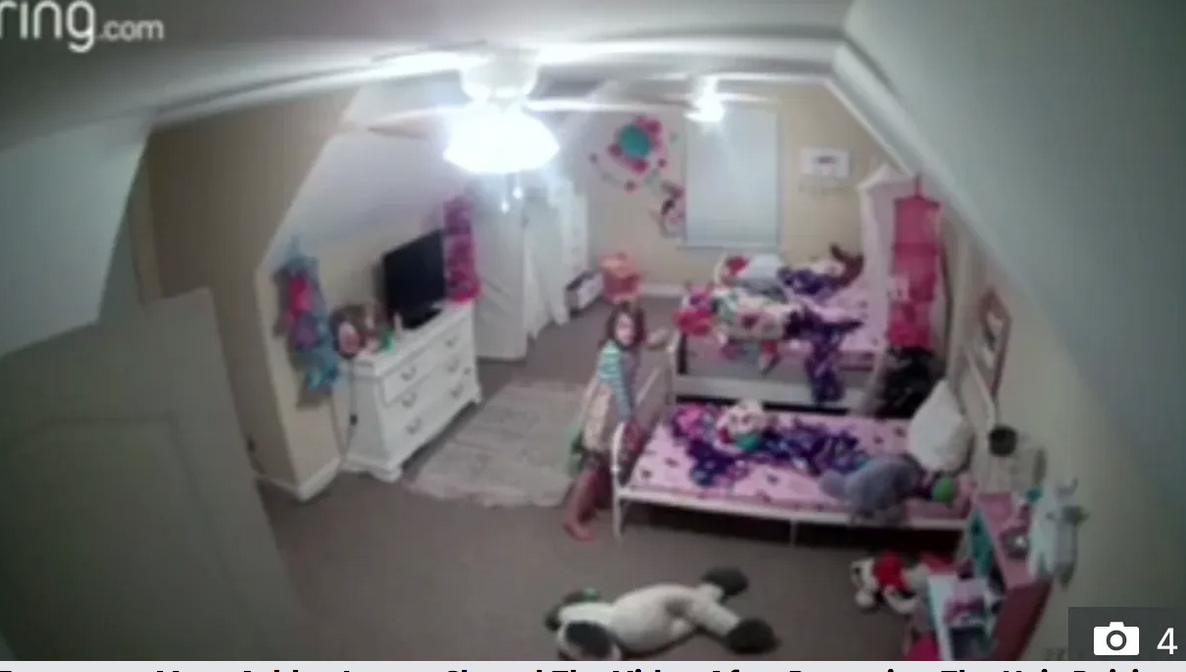
“We are aware of incidents discussed below where employees violated our policies,” the letter from Ring, dated January 6, reads.
“Over the last four years, Ring has received four complaints or inquiries regarding a team member’s access to Ring video data,” it continues. Ring explains that although each of these people were authorized to view video data, their attempted access went beyond what they needed to access for their job.
“In each instance, once Ring was made aware of the alleged conduct, Ring promptly investigated the incident, and after determining that the individual violated company policy, terminated the individual,” the letter adds.
As well as firing workers, Ring has also taken steps to limit such data access to a smaller number of people, the letter reads. It says three employees can currently access stored customer videos.
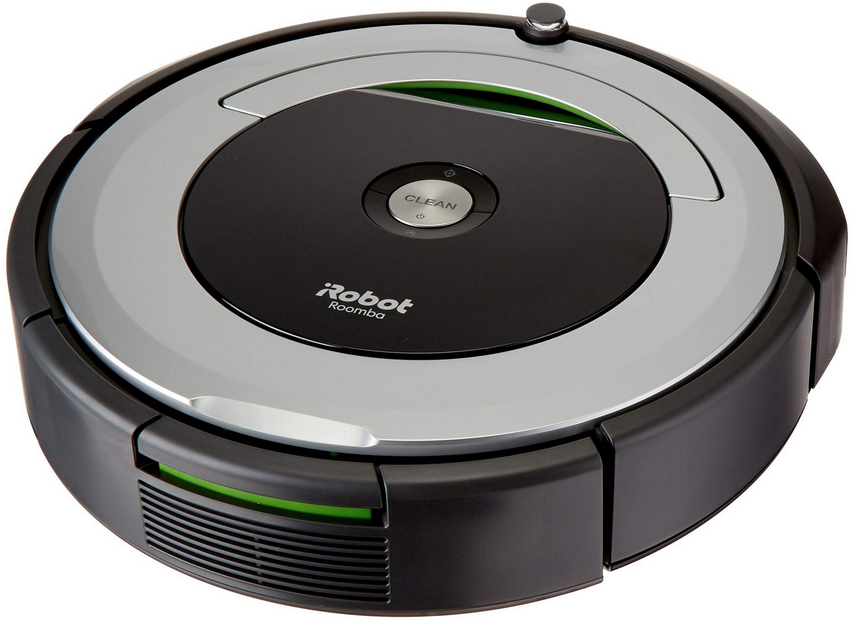
As The Intercept previously reported, Ring granted a number of workers in Ukraine access to Ring user video for research purposes. In the new letter, Ring says “The R&D team in Ukraine can only access publicly available videos and videos available from Ring employees, contractors, and friends and family of employees or contractors with their express consent.”
Ring’s letter was in response to one multiple Senators sent to the company in November 2019. In that, Senators Ron Wyden, Chris Van Hollen, Edward J. Markey, Christopher A. Coons, and Gary C. Peters asked Ring multiple questions about the security of Ring’s systems.
In response to a wave of incidents where hackers broke into Ring users’ accounts and then harassed customers through their devices, Ring has implemented a number of new security features, such as requiring new signups to use two-factor authentication.
In December Motherboard found multiple security issues with the Ring platform, such as Ring allowing logins from unknown IP addresses. Ring has since introduced warning messages when someone logs in from a new location.
“Requiring two-factor for new accounts is a step in the right direction, but there are millions of consumers who already have a Ring camera in their homes who remain needlessly vulnerable to hackers. Amazon needs to go further—by protecting all Ring devices with two-factor authentication.
It is also disturbing to learn that Ring’s encryption of user videos lags behind other companies, who ensure that only users have the encryption keys to access their data,” Senator Wyden said in a statement.
When asked specific questions on the termination of employees who abused data access, a Ring spokesperson told Motherboard in an email, “We do not comment on personnel matters.”
Updated: 1-31-2020
Third-Party Trackers Are Pulling Your Data Off Ring’s Android App
Ring, the home security company owned by Amazon, promises to watch the world around you and keep your property safe. But the doorbell app is also surveilling its users, sending personally identifiable information out to third party vendors, according to a new report from the Electronic Frontier Foundation (EFF), the San Francisco civil liberties nonprofit.
Bill Budington, the senior staff technologist who wrote the report, tested the Ring for Android version 3.21.1 app, finding that it was sharing data such as IP addresses, full names, email address, information about whether bluetooth is enabled, and even sensor data from the device being used to access the app.
Budington identified four main companies that received this information, including Branch, which calls itself a “deep linking” platform (meaning it takes people to specific web pages or products).
Facebook also received information such as a person’s time zone and was alerted when the app is opened.
AppsFlyer, a big data firm, received information such as when users engage with the Neighbors section of the app, as well as where you installed the app from, and when it was first launched.
Mixpanel, a business analytics company that tracks user engagement with apps, received the most identifiable data, such the number of locations a where a user has Ring devices installed, and users name and emails.
Analytics companies take these discrete forms of data and combine it with other internet user data to create a cohesive picture of device usage.
“This cohesive whole represents a fingerprint that follows the user as they interact with other apps and use their device, in essence providing trackers the ability to spy on what a user is doing in their digital lives and when they are doing it,” writes Budington.
This is the most recent in a long line of revelations involving Ring. For example, it partnered with more 400 police departments in sharing device images to accidentally exposing the data of more than 3,000 users, including login details and names of Ring devices (which are often labeled with terms like “bedroom”), and created neighborhood wide panopticons in which neighbors are surveilling neighbors, and paying for the privilege to do so.
Considering Amazon has a patent for “surveillance as a service” (delivery drones perform aerial surveillance at the property of an “authorized party”) along with its facial recognition technology, it’s worth considering how services you use to watch the world are also watching you.
Updated: 8-5-2022
Amazon’s Roomba Deal Is Really About Mapping Your Home
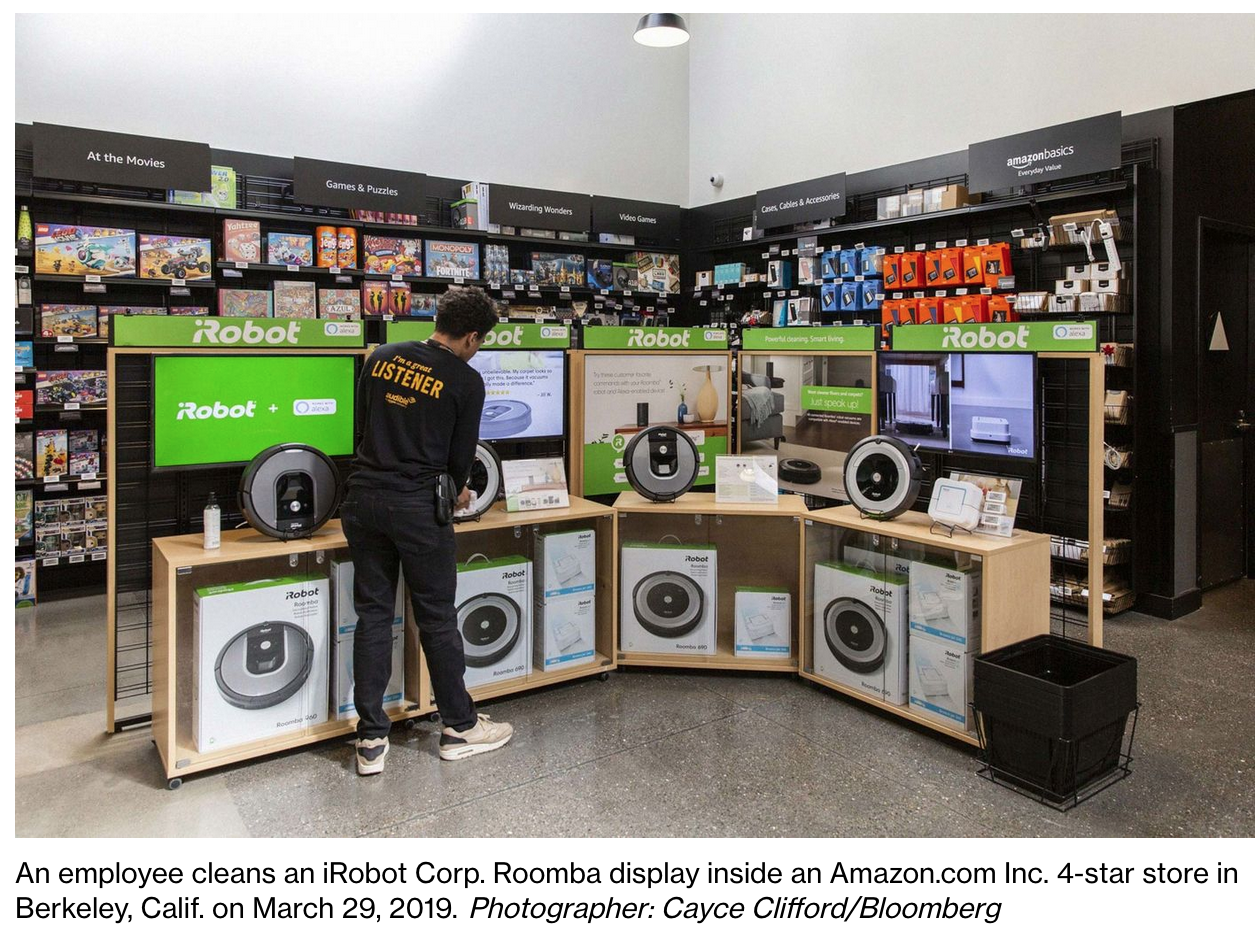
In buying iRobot, the e-commerce titan gets a data collection machine that comes with a vacuum.
Amazon.com Inc. hasn’t just bought a maker of robot vacuum cleaners. It’s acquired a mapping company. To be more precise: a company that can make maps of your home.
The company announced a $1.7 billion deal on Friday for iRobot Corp., the maker of the Roomba vacuum cleaner. And yes, Amazon will make money from selling those gadgets. But the real value resides in those robots’ ability to map your house. As ever with Amazon, it’s all about the data.
A smart home, you see, isn’t actually terribly smart. It only knows that your Philips Hue lightbulbs and connected television are in your sitting room because you’ve told it as much.
It certainly doesn’t know where exactly the devices are within that room. The more it knows about a given space, the more tightly it can choreograph the way they interact with you.
The smart home is clearly a priority for Amazon. Its Echo smart speakers still outsell those from rivals Apple and Google, with an estimated 9.9 million units sold in the three months through March, according to the analysis firm Strategy Analytics.
It’s complemented that with a $1 billion deal for the video doorbell-maker Ring in 2018, and the wi-fi company Eero a year later.
But you still can’t readily buy the Astro, Amazon’s household robot that was revealed with some fanfare last year, is still only available in limited quantities. That, too, seemed at least partly an effort to map the inside of your property, a task that will now fall to iRobot.
The Bedford, Mass.-based company’s most recent products include a technology it calls Smart Maps, though customers can opt out of sharing the data. Amazon said in a statement that protecting customer data is “incredibly important.”
Slightly more terrifying, the maps also represent a wealth of data for marketers. The size of your house is a pretty good proxy for your wealth. A floor covered in toys means you likely have kids.
A household without much furniture is a household to which you can try to sell more furniture. This is all useful intel for a company such as Amazon which, you may have noticed, is in the business of selling stuff.
What’s more, the acquisition looks like a snip for the retailer, which had $61 billion of cash at the end of June. The $1.7 billion deal represents a 22% premium to iRobot’s share price before the deal was announced. Less than a year ago, iRobot was valued at $2.5 billion.
And it won’t take much to cover the target’s cost of capital. Its predicted profit may only be about $78 million next year, but it also has sales, marketing, and administrative costs of $389 million, a number that Amazon can surely bring down by pumping the products through its existing sales channels.
Amazon would not be alone in wanting to map your home. Apple Inc. also unveiled a tool in June for the next release of iOS, its mobile operating system, that uses the laser scanner on the latest iPhones to build 3-D models that it’s dubbed “RoomPlan”.
Amazon’s 2017 deal for Whole Foods gave it insights into the grocery industry. The $3.5 billion deal announced for One Medical Ltd. last month provides a wealth of health-care data. Now iRobot can give Jeff Bezos & Co. a sense of what’s in your home.
Amazon Buying Roomba Maker iRobot for $1.7 Billion
Deal for robot vacuum adds to Amazon’s connected-home portfolio.
Amazon.com Inc. is buying Roomba maker iRobot Corp. for $1.7 billion, giving the online retailer another connected-home product that deepens its ties to consumers’ homes.
Amazon agreed to pay $61 a share for iRobot in an all-cash deal. The price, which includes a small amount of debt, represents a 22% premium to iRobot’s closing price of $49.99 on Thursday.
IRobot shares rose 19% to $59.54 in recent trading. They are off 9.7% year to date. Amazon shares fell 0.8% to $141.41.
IRobot introduced its Roomba vacuum in 2002 and has sold more than 40 million units since. The wireless, smart-vacuum learns and maps spaces to clean dust and messes. It is a staple of Amazon’s Prime Day shopping bonanza, having been a featured product for eight straight years.
IRobot in May had projected reaching sales of $1.6 billion to $1.7 billion this year. It withdrew that guidance on Friday in light of the deal and other challenges.
Roomba would join other Amazon-owned products like the Alexa virtual assistant speaker and Ring video doorbell that together give the retailer more ways to power smart homes.
IRobot would be the fourth-largest acquisition by Amazon, ranking behind the 2017 acquisition of Whole Foods for $13.7 billion, an $8.5 billion purchase of movie studio MGM in March and last month’s agreement to buy 1Life Healthcare for $3.9 billion.
The deal comes as iRobot is struggling. On Friday, it reported a 30% drop in second-quarter sales, which came in at $255.4 million, and a net loss that widened to $43.4 million, or $1.60 a share, from $2.8 million, or 10 cents a share, in the year-ago quarter.
IRobot said that the latest quarter’s results were hurt by reduced orders, supply-chain problems and a stronger dollar.
The company said that it is also laying off 140 employees, or about 10% of the global workforce, as well as taking other measures to cut costs by up to $10 million this year.
IRobot Chief Executive Colin Angle will remain in his position upon completion of the acquisition, which requires approval from shareholders.
Amazon’s iRobot Deal Seen Facing Tough FTC Antitrust Review
* FTC Chair Lina Khan Has Pushed Tougher Scrutiny Of Tech Deals
* Critics Allege Amazon Seeking To Dominate Smart Home Space
Amazon.com Inc. is barrelling ahead with an aggressive acquisition strategy despite intense antitrust scrutiny in Washington, with its $1.65 billion deal to buy Roomba vacuum maker iRobot Corp. as the latest example.
Antitrust experts say the deal is expected to draw a tough review from the US Federal Trade Commission led by Chair Lina Khan, a critic of the e-commerce platform’s market dominance. The agency will also review Amazon’s $3.49 billion deal last month to buy 1Life Healthcare, the parent of One Medical.
The FTC didn’t challenge Amazon’s purchase of MGM Studios earlier this year, but that was before Khan had a Democratic majority on the commission.
Close scrutiny of Amazon’s iRobot transaction won’t necessarily result in a challenge, and even if the FTC does sue to block the deal, there’s a chance it wouldn’t prevail.
Hal Singer, managing director at Econ One, a litigation consulting firm, said the FTC could have a hard time winning a merger challenge on the deal.
“I want them to try and challenge these things but I worry about their current evidentiary burden,” said Singer, who has served as an economics expert in antitrust cases.
“Antitrust law has contorted itself where it’s largely feckless” in recent merger challenges where the companies weren’t direct competitors.
Khan has pushed the FTC to take a harder look at acquisitions by the biggest tech firms in the wake of a report by the agency last year that found Alphabet Inc.’s Google, Amazon, Apple Inc., Meta Platforms Inc. and Microsoft Corp. used loopholes to avoid antitrust scrutiny on hundreds of smaller deals.
Last week, the agency sued to block Meta’s acquisition of virtual reality startup Within, the first time the FTC has preemptively sought to block a deal by the social networking giant.
iRobot’s Roomba dominates the smart vacuum market with a 75% market share by revenue in the US, according to industry database Statista.
Amazon introduced its own offering last fall, a three-wheeled device called Astro, which sells for about $1,450. Astro, still in a limited rollout, hasn’t made a splash with consumers.
Amazon is “basically taking out their largest competition in a market they want to dominate,” said Sarah Miller, executive director of anti-monopoly advocacy group American Economic Liberties Project. “Buying what is your biggest competitor should be an antitrust violation.”
Beyond that, the deal also could have anticompetitive effects, said Amanda Lewis of the law firm Cuneo, Gilbert & LaDuca LLP.
The acquisition “would put Amazon in a position to disadvantage rivals on the platform and block access to important tools to reach new customers, like buying ads on Amazon.com,” said Lewis, who led the Amazon section of the 2020 congressional investigation into competition in online markets.
An Amazon spokesperson said Friday that the company would continue to supply retailers with iRobot products and sell competing devices on Amazon’s retail websites.
That promise may not be enough. The company made a similar pledge with its other major robotics deal — the 2012 acquisition of industrial bot builder Kiva Systems. Later Amazon stopped selling the devices to other companies, using them exclusively to supply its own warehouses.
The 2020 House probe found that Amazon has made significant investments into building out smart home systems based around its Alexa voice assistant.
It’s acquired a number of companies with that aim, the report said, including the Ring smart security system in 2018 and a year later Eero, a router designed to make it easier for customers to set up smart home devices.
Adding iRobot’s Roomba to Amazon’s offerings alongside Alexa and Ring could lock-in consumers to the company’s smart home products, said Alex Harman, director of competition policy at the Economic Security Project.
“Once you have your whole house tied to one company, how can you justify the cost of switching?” he said.
The 2019 Eero acquisition may have helped Amazon decide to acquire iRobot by providing insights into how frequently and when consumers use their smart vacuums, said Stacy Mitchell, co-executive director of Institute for Local Self-Reliance.
Amazon is using its data collection and acquisitions to help it dominate the smart home in the same way that it has e-commerce, she said.
“The smart home is going to become a powerful new platform that the Big Tech companies and Amazon in particular see as an opportunity to gain and exercise market power,” said Mitchell, who has studied Amazon for years. “Any other company that wants to participate in this arena is going to have to play according to Amazon’s rules.”
Miller from Economic Liberties noted that bipartisan legislation introduced in Congress would bar Amazon from this kind of acquisition.
“Congress really needs to act at this point,” she said. “The FTC cannot be the only one in the arena.”
Amazon’s Roomba Deal Has Shades of Fitbit
Acquisition of iRobot won’t make a dent financially, but a commanding market share could draw Washington’s gaze.
Amazon’s plan to buy Roomba is in part a bet that Facebook’s lawyers will clean up their mess.
Amazon, the world’s largest tech company by annual revenue, is seriously pushing back against the notion that there is too much heat in Washington for tech giants to undertake significant acquisitions.
Its plan to acquire iRobot, maker of the Roomba robot vacuum, for $1.7 billion in cash that was announced Friday morning comes just two weeks after the company announced a $3.9 billion deal to buy primary healthcare provider One Medical.
And that came just four months after Amazon closed its $8.5 billion buyout of Hollywood studio MGM, which the Federal Trade Commission said at the time it could still challenge.
iRobot’s shares were trading just 2% below the proposed purchase price Friday afternoon following the announcement, suggesting investors aren’t too worried about the ultimate outcome.
It is certainly an opportunistic move for Amazon, with iRobot’s shares nearly 70% off their peak from early 2021 as the company has struggled with component shortages and swings in demand.
iRobot has missed Wall Street’s revenue target in its past three quarterly reports, and the 16% miss reported in Friday’s second-quarter results was the biggest yet.
The deal also won’t make a dent financially. iRobot’s current base of about $1.4 billion in annual revenue is just a little more than what Amazon generates in a single day.
But, unlike One Medical, which is a relatively small player in the widely dispersed business of primary-care doctors, the Roomba maker has a commanding lead in the market it pioneered.
iRobot told investors at an analyst meeting in December that it has a 75% share of the North American market of robot vacuums and 62% of the global market excluding China.
That makes this deal more akin to Google’s acquisition of Fitbit, completed last year. The connected fitness-device maker’s business was a pittance to the $155 billion in annual revenue Google parent Alphabet was generating at the time.
But Fitbit still had about a 10% share of the market for wearable devices at the time, plus a base of about 29 million users who would all be sending their very heartbeats to a company whose predominant business is selling targeted advertising.
The prospect made many nervous: It took Google 15 months to close the deal, and only after making concessions to regulators that it wouldn’t use Fitbit data in its ad business.
Amazon, of course, already has robots rolling around the home—and flying around it as well. It also sells loads of robot vacuums from other makers on its site, and the recent strength of its third-party business, along with scrutiny about how it treats its own products on its site, will likely keep the e-commerce giant from pushing the Roomba too hard onto customers.
Amazon might also be betting that big tech peer Meta Platforms makes its job a bit easier. The Facebook parent was sued by the FTC last month, with the agency trying to block its acquisition of the company behind the virtual-reality fitness app called Supernatural.
The FTC’s claim is that the company that has rebranded itself as all about the metaverse is yet again trying to “buy its way to the top.”
But Facebook has successfully fended off the FTC before, and another victory here could help curb the agency’s stated ambitions to bring big tech to heel. That may be needed if Amazon is going to keep trying to suck up opportunistic deals.
Updated: 12-19-2022
Amazon Ring Cameras Used In Nationwide ‘Swatting’ Spree, US Says
* Two Indicted For Placing 12 Hoax Calls, Taunting Police
* Defendants From Wisconsin And North Carolina Face Charges
Two people who hacked Yahoo! email accounts to gain access to Ring home security cameras have been charged over a weeklong “swatting” spree that involved placing bogus emergency calls and live-streaming the armed police responses on social media, according to a Los Angeles grand jury indictment, the US Justice Department said.
Kya Christian Nelson, 21, of Racine, Wisconsin, and James Thomas Andrew McCarty, 20, of Charlotte, North Carolina, were charged with conspiracy to access computers without authorization.
Nelson, who is currently incarcerated in Kentucky in an unrelated case, was also charged with two counts of intentionally accessing a computer without authorization and two counts of aggravated identity theft.
The series of swatting incidents prompted the FBI to issue a public service announcement in late 2020 urging users of smarthome security cameras to use unique passwords with two-factor authentication.
Nelson and McCarty face a maximum of five years in prison for the conspiracy charges. A charge of aggravated identity theft carries a mandatory two-year consecutive sentence.
“Swatting is a serious crime, and those responsible for it should be brought to justice,” Ring spokesperson Emma Daniels said in an emailed statement. “We take the security of our customers extremely seriously — that’s why we made two-step verification mandatory, conduct regular scans for Ring passwords compromised in non-Ring breaches, and continually invest in new security protections to harden our systems.”
Yahoo! didn’t immediately respond to a request for comment.
The pair allegedly gained access to 12 Ring home security cameras in nine states in November 2020 and placed fake emergency calls to local law enforcement agencies to summon police to the homes where the cameras were located.
They then streamed the police response on social media, according to the Justie Department. During several of the incidents, they taunted police officers and the victims through the Ring devices, prosecutors said.
In one instance, a hoax call was made to police in West Covina, California, with the caller pretending to be a minor reporting her parents were drinking and shooting guns in the home. Nelson allegedly accessed the Ring camera and used it to taunt and threaten the responding police officers, prosecutors said.
Updated: 2-12-2026
When Home Security Cameras Violate Your Privacy!
The devices come with a trade-off: When companies store our footage, we don’t always have control over how it’s used or shared.
Most people get security cameras for, well, security. They hope the devices will deter criminals, or at least catch bad guys in the act.
But fundamental privacy questions, like what happens to the videos and who owns the footage, should be part of the calculus when installing the devices.
Just Consider These Two Recent Events:
Nancy Guthrie, the missing mother of “Today” co-anchor Savannah Guthrie, had a Google Nest camera, but not a subscription to view older recordings. Yet law enforcement still managed to access and share a clip.
Some Nest owners were surprised to learn that, yep, even if you aren’t paying for cloud storage, your recordings could still be floating around Google servers.
Then, there was Ring’s Super Bowl ad for Search Party, a new feature that can analyze footage from cameras around your neighborhood to help find a missing dog.
It’s a sweet idea, but some people couldn’t shake the creep factor.
Wait, Ring’s default settings allow it to tap in to my personal recordings? Could it be used for more than just a wayward puppy?
Most home-security camera makers, such as Google and Amazon, which owns Ring, have access to your footage—and, when legally compelled, can share it with law enforcement.
Some readers have told me the peace of mind is worth the privacy trade-off. Others are disturbed by their videos being viewed by anybody but them.
Your Digital Paper Trail
A growing share of households—currently 30% of U.S. residences with internet access—own a security camera or video doorbell, according to data from the research firm Parks Associates.
They capture all sorts of activity, from roaming wildlife, to delivery drivers dropping off packages, to potential criminal activity.
Shortly after Nancy Guthrie’s disappearance from her home in Arizona, local authorities said software had detected a person on the door camera but there was no video available, because “they had no subscription.”
Then, days later, law enforcement released the video with a Nest watermark.
I, too, own a Google Nest camera without a subscription. I can only review 10-second motion clips from the past six hours. If I want more, I need to pay $10 monthly for 30 days of history, or $20 for 60 days.
But even if you pay nothing for storage, Google still uploads your Nest clips and keeps them, at least for a time. Google says video is deleted from the cloud “after a certain number of days,” but doesn’t specify how long.
In the Guthrie case, authorities said the video was “recovered from residual data located in backend systems.” Google didn’t comment on its involvement.
“Residual data” was a head-scratcher to me. Hany Farid, a professor at the University of California, Berkeley, who focuses on digital forensics, explained that when you delete a photo on your phone, it may no longer be visible to you, but it’s still stored on the phone’s disk.
The same goes for security-camera footage on a server.
Forensic software can help recover the files, Farid said, with a caveat: “The longer you wait, the less likely you are to find it, because the computer will eventually reclaim that memory.”
However the data was salvaged, the fact remains: Google and other security-camera makers such as Arlo and Ring have access to your videos—sometimes after you don’t.
The data may be encrypted to fend off hackers, but the companies can decrypt and, if presented with a warrant, share it.
Google reports the number of legal requests it receives every six months.
There’s an alternative. End-to-end encryption can hide videos from even the companies hosting the data. In this case, only the camera owner has the key to decrypt the recordings.
Ring has an opt-in end-to-end encryption feature for select camera models.
Nest and Arlo don’t. For devices that work with Apple’s HomeKit Secure Video, full encryption is the default.
End-to-end encryption comes with its own compromises—with Ring, you give up 20-plus features, such as video search, when you turn it on.
Apple’s system also limits footage to 1080p, even if the camera supports higher resolution.
Neighborhood Watch
Ring’s Search Party can leverage the company’s large network of outdoor cameras and use AI to help reunite missing dogs with their humans. But some humans bristled after seeing a recent TV ad for the feature.
“The minute they showed the zoom out of all the cameras syncing to scan for a target, my heart sank to my stomach and I was filled with dread,” one commenter wrote on the YouTube video.
At a time when federal agencies are using facial recognition and other technology to speed up arrests, the concern is understandable.
It’s not a leap to imagine millions of coordinated video doorbells being used for a similar purpose.
Jamie Siminoff, who founded Ring and heads the Amazon subsidiary, said that’s a misunderstanding of the feature.
It’s built specifically for dogs right now, he said, “because with all of these other use cases, there are unintended consequences we want to think about.”
He noted that Search Party has located one dog a day, on average, since launching last fall. If your Ring device spots Fido, you have the option to share the footage with the owner—or not.
But would the feature ever extend beyond canines? Cats, surely—the company is working on locating other pets.
And in October, Siminoff told us, “There are thousands of people missing with dementia all the time, so you can imagine looking for them.”
Search Party alerts are turned on by default for Ring subscribers in the U.S. You can disable the feature by going to the menu, then Control Center.
I asked about the company’s partnership with Flock Safety—which was announced in October to facilitate local law enforcement requests for footage from Ring users, who can share videos if they want.
Flock also works with Immigration and Customs Enforcement. Siminoff said Ring hasn’t integrated with Flock yet, “and we have zero integration with ICE.”
Later Thursday, Ring said that, after a “comprehensive review,” it decided the Flock integration would “require significantly more time and resources than anticipated” and that the companies decided to cancel the plans.
It said no Ring customer videos were ever sent to Flock.
Still, in our quest to catch the neighborhood porch pirate, we’ve inadvertently built a dragnet that catches much more.
Until end-to-end encryption becomes the industry standard, we are recording—and potentially sharing—a digital history. Our data floats in the cloud, until a warrant brings it back to earth.
Related Articles:
Doorbell Camera Owners Value Entertainment Over Security (#GotBitcoin?)
New Spy Service Shows You Unsecured Webcams And Baby-Cams, Etc. (#GotBitcoin?)
Cyber-Espionage Experts Want to Know Who’s Exposing China’s Hacking Army (#GotBitcoin?)
Chinese Hackers Breach U.S. Navy Contractors (#GotBitcoin?)
U.S. Charges China Intelligence Officers Over Hacking (#GotBitcoin?)
U.S. Charges Chinese Agents In Hacking Scheme, More Cases Expected (#GotBitcoin?)
Leave a Reply
You must be logged in to post a comment.